Burger Ingredient Order Is Not Random: The Structural Science of the Stack
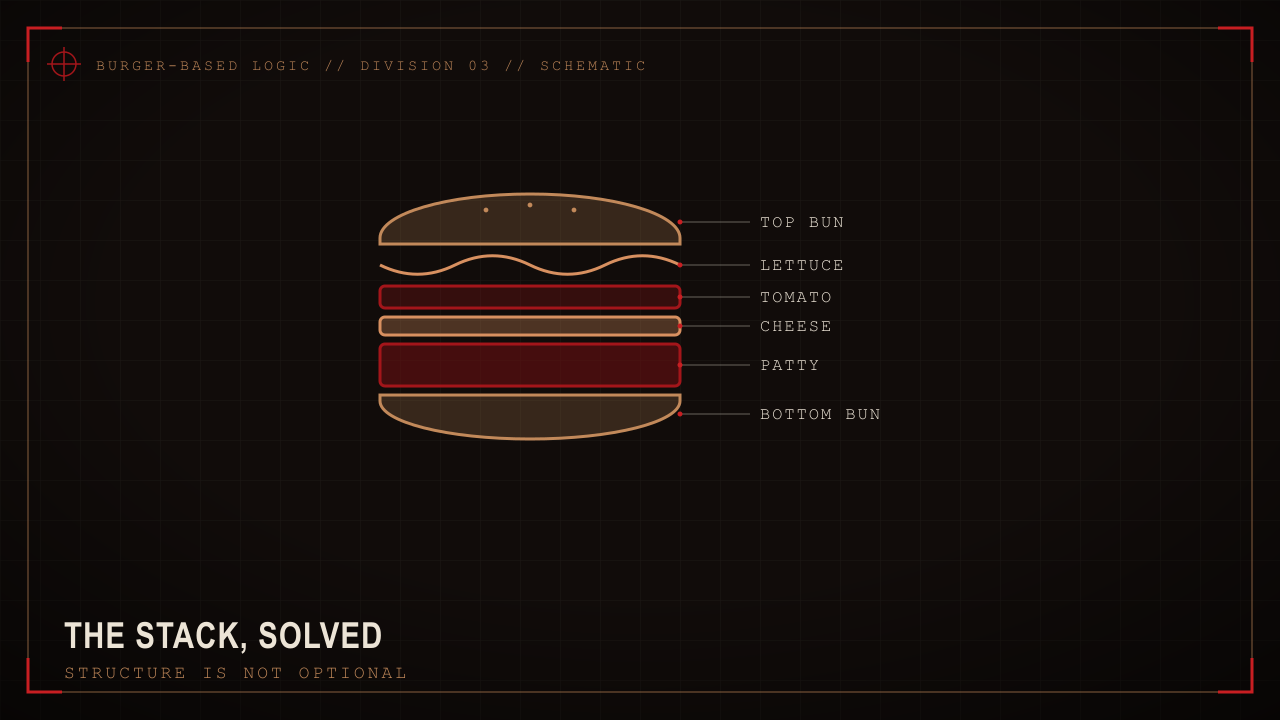
Top bun. Sauce. Lettuce. Tomato. Cheese. Patty. Bottom bun. This is not a suggestion. Every element of this sequence has a structural, thermal, or flavour-based justification. Deviate and your burger falls apart. Literally.
There is a correct order in which to stack burger ingredients. This is not a matter of preference, and I will not be entertaining the notion that it is. It is a matter of physics, food science, and structural engineering. The order that nearly every serious burger operation converges on — bun, sauce, lettuce, tomato, onion, cheese, patty, bun, reading top to bottom — was not handed down by tradition for its own sake. It was discovered, the hard way, across decades of burgers falling apart in people's hands.
I approached this the way I approach everything: assuming the conventional wisdom was arbitrary until proven otherwise. It is not arbitrary. Every single position in that stack is load-bearing, in either the literal or the thermal or the chemical sense. Let me walk you through the dossier, layer by layer.
The Bottom Bun: The Foundation
The bottom bun is the foundation, and foundations fail from water. Its entire job is to bear the structural load of everything above it without disintegrating, and the thing that makes a bun disintegrate is moisture. A soggy bottom bun is the single most common cause of catastrophic burger failure — the structural collapse where the whole thing slumps out the back and into your lap.
The solution is the placement of the patty. The patty goes directly on the bottom bun, and this is not casual — it is a deliberate moisture barrier. A properly cooked patty has a seared, fat-rendered surface that resists water. Sitting it directly on the bottom bun means the bun's first point of contact is with something hydrophobic and warm, not with the wet, slick underside of a tomato slice. The patty shields the foundation. Put juicy tomato on the bare bottom bun instead and you have begun demolishing your burger from the ground up before you've even taken a bite.
The Cheese Position
Cheese goes on the patty. On it — fused to the hot upper face of the meat — not floating somewhere higher in the stack. The reason is adhesion chemistry. Cheese laid on a patty straight off the heat begins to melt into the meat's surface immediately, forming a bonded, semi-molten layer that physically welds the cheese to the protein. That bond is both a flavour event and a structural one: the melted cheese becomes the mortar between the patty and everything stacked above it.
Place that same cheese higher up — above the tomato, say — and it never gets hot enough to melt. Now you have a slick, cold, solid slab of cheese sitting in the middle of your stack, and a cold cheese slice is one of the most treacherous surfaces in all of sandwich construction. It doesn't grip. It glides. It becomes a frictionless slip plane, and the entire payload of toppings above it slides sideways and ejects out the far side of the bun on first compression. Cold cheese is a structural saboteur. Hot cheese is glue. The position determines which one you get.
The Tomato and Lettuce Placement
Tomato sits above the cheese; lettuce sits above the tomato. Neither placement is decorative. The tomato is the most structurally hostile ingredient in the entire build — wet, heavy, smooth-surfaced, and prone to sliding. Resting it on the melted, slightly tacky cheese layer gives it the grippiest possible bed; the cheese helps anchor a topping that otherwise wants to escape. Put the tomato anywhere with less friction and it will find the exit.
Lettuce goes above the tomato for two distinct reasons, and both are real engineering. First, it forms a moisture buffer between the wet tomato and the top bun, intercepting juice that would otherwise wick straight up and ruin the bread's structural integrity from above. Second — and this is the part nobody appreciates — the fibrous, crinkled surface of lettuce catches against the sauced underside of the top bun, increasing friction at the top of the stack and reducing the tendency of the whole assembly to shear apart when you bite down and compress it.
Lettuce is doing load-bearing structural work. It is friction management and moisture control in a single leaf. It is not garnish. Remove it and your burger is a hard drive with no mounting screws — all the right parts, nothing holding them in place.
The Sauce Logic
Sauce belongs up top, on the crown bun, above the lettuce — never down on the patty against the bottom bun. The reasoning is by now familiar: sauce is liquid, the bottom bun is the moisture-vulnerable foundation, and you do not introduce free liquid to the one component whose failure ends the whole structure. Up top, the sauce is held in check by the lettuce barrier beneath it and absorbed gently by the toasted interior of the crown, which is structurally expendable in a way the load-bearing base is not. Sauce flows downhill. Engineer the stack so that when it does, it doesn't reach the foundation.
Deviations and Their Consequences
Every deviation from the canonical order has a predictable, diagnosable failure mode, and once you know them you start seeing them in every poorly built burger you're handed. Cheese above the tomato: lateral slide, toppings ejected on first bite. Sauce against the bottom bun: foundation goes soggy within about three minutes and the base fails. Lettuce beneath the tomato: the lettuce gets soaked, contributes no friction, and the moisture barrier is gone. Tomato on the bare bottom bun: the fastest known route to total structural collapse, demolition from the ground up.
The Verdict
The correct order was not invented by a committee and it was not inherited from custom. It was discovered — the residue of applying a brutal set of constraints to a stack of meat and bread and vegetables: hold together under compression, retain heat, balance flavour, and survive the journey from kitchen to table in a paper bag without becoming a tragedy. Run those constraints for long enough across enough burgers and the optimal sequence falls out of the chaos on its own. It converges, every time, on roughly the same stack.
So respect the order. It is the accumulated structural wisdom of every burger that ever fell apart so that yours wouldn't have to. The order is not a tradition. The order is the burger. Question everything — then build it in the right sequence.
The Burger as a Load-Bearing Structure
Before we revisit each layer, let's establish the governing principle, because once you see a burger as a structure subject to forces rather than a pile of ingredients, every assembly choice becomes an engineering decision with a right and wrong answer. A burger in the hand is under constant assault from physics. Gravity pulls every layer downward. The compression of your bite drives the whole stack together and generates shear — the sideways force that makes toppings squirt out the far side. And moisture, the silent saboteur, migrates through every component, weakening the structural members from within.
A well-built burger is a structure engineered to survive all three: gravity, shear, and moisture, for the full duration between assembly and final bite, often including a journey in a paper bag. The canonical ingredient order is not tradition or whim. It is the accumulated, hard-won solution to a structural problem, discovered the way most engineering is discovered — through countless failures, each soggy collapse and lateral blowout teaching the next iteration what not to do. We are reverse-engineering a solution that the burger industry arrived at empirically, and finding, as we always do, that the empirical answer obeys the physics.
The Bottom Bun: Foundation Engineering
Every structure begins with its foundation, and in a burger the foundation fails from exactly one cause: water. The bottom bun bears the entire load above it, and its enemy is moisture, which dissolves the gluten network that gives bread its structural integrity, turning a firm foundation into wet, collapsing pulp. A soggy bottom bun is the single most common catastrophic burger failure — the back-end slump where the whole payload slides out into your lap.
The defense is the placement of the patty directly on the bottom bun, and this is deliberate moisture engineering. A properly cooked patty has a seared, fat-rendered surface that is hydrophobic — it repels water. Sitting it against the bottom bun means the foundation's first contact is with something warm and water-repelling, not with the dripping underside of a tomato. The patty is a damp-proof course, the same concept as the moisture barrier a builder lays between wet ground and the base of a wall. Put juicy tomato or a pool of sauce on the bare bottom bun instead and you have begun demolishing the building from its foundation before the first bite. Foundations fail from water. Keep the water off the foundation.
The Patty and the Thermal Argument
The patty's position serves a second function beyond moisture defense, one that ties this structural analysis to the thermodynamics of the stack. Placed at the base, against the toasted bottom bun, the patty's considerable heat is partly insulated from below by the bread and trapped within the core of the assembly rather than radiating away into the open air. The bun acts as a thermal blanket on the underside.
This matters because heat is what drives the cheese's behavior, and the cheese is the structural keystone of the entire build, as we are about to see. A patty positioned to retain its heat keeps the cheese above it molten and working. A patty that has dumped its heat into the wrong places leaves the cheese cold, solid, and treacherous. The thermal logic and the structural logic are not separate arguments. They are the same argument, because in a burger, heat is what activates the adhesives.
The Cheese: Structural Keystone
We come to the most important and most violated rule in burger construction: cheese goes on the patty, fused to its hot upper face, and nowhere else. The reason is adhesion chemistry, and getting it wrong converts the burger's strongest joint into its weakest. Cheese laid on a patty straight off the heat begins to melt into the meat's surface immediately, forming a bonded, semi-molten layer that physically welds to the protein and then, cooling slightly, grips everything stacked above it. Hot cheese is the mortar of the burger.
Place that same slice higher in the stack — above the tomato, say — and it never reaches melting temperature. Now you have a cold, solid, slick slab of cheese floating in the middle of the structure, and a cold cheese slice is one of the most treacherous surfaces in all of sandwich engineering. It has almost no friction. It does not grip; it glides. It becomes a frictionless slip plane, a ball-bearing layer, and on the first compression of a bite the entire payload of toppings above it shears sideways and ejects out the opposite side of the bun. The single decision of where to place the cheese determines whether it is the structure's strongest weld or its built-in failure plane. Hot and low: keystone. Cold and high: saboteur.
Cold cheese in the middle of a burger is a fault line waiting for a bite. You have, with one careless placement, installed a frictionless bearing at the heart of a structure that is about to be compressed. Engineers spend careers removing slip planes from buildings. Do not put one in your lunch on purpose.
Tomato and Lettuce: Friction and Drainage
Above the cheese sit the tomato and then the lettuce, and neither placement is decorative — each is solving a specific structural problem. The tomato is the most hostile ingredient in the entire build: wet, heavy, smooth on both faces, and constantly trying to slide. Resting it on the slightly tacky surface of the melted cheese gives it the grippiest available bed, anchoring the topping that most wants to escape. Place the tomato anywhere with less friction beneath it and it will find the exit on the first bite.
Lettuce goes above the tomato for two distinct and genuine engineering reasons. First, it is a drainage and moisture barrier: its layered, water-shedding leaves intercept juice — from the tomato below and any sauce above — that would otherwise wick into the top bun and rot the crown from within. Second, and almost universally unappreciated, its crinkled, fibrous surface generates friction against the sauced underside of the top bun, gripping the crown in place and resisting the shear that tries to slide the whole upper assembly off sideways during a bite. Lettuce is doing structural work in two directions at once — drainage downward, friction upward. It is the most underestimated component in the build.
Sauce and the Crown: Managing the Liquid
Sauce is the burger's free liquid, and free liquid is always a structural threat, so its placement follows directly from the foundation principle: sauce belongs up top, on the crown bun above the lettuce, never down against the moisture-vulnerable bottom bun. From the crown, gravity will inevitably pull the sauce downward — but engineered correctly, it descends onto the lettuce barrier, which intercepts and holds it, keeping it away from the load-bearing base.
The toasted interior of the crown bun does additional work here. Toasting denatures the surface of the bread and creates a partial moisture seal — a crust that resists immediate saturation, buying the structure precious minutes before sauce can soak through. This is why a serious burger toasts the inner faces of both buns: not for flavor alone, but to install a moisture-resistant lining on the components most exposed to liquid. The crown is structurally expendable in a way the base is not — if the top bun softens slightly, the burger survives; if the bottom bun fails, the burger is over. So you route the liquid toward the part that can afford to get wet.
The Onion, the Pickle, and the Edge Cases
A complete analysis has to account for the supporting cast, because even the minor ingredients have correct positions dictated by their physical properties. Raw onion, with its rigid, curved, slippery rings, is a structural wildcard — best diced or placed where its slick surfaces won't create a slip plane, typically nestled against the patty or cheese where the melt can help anchor it rather than floating loose where it will slide. Pickles, thin and wet, belong near the patty or cheese for the same reason, kept away from the bottom bun whose sogginess they would accelerate.
Caramelized onions are a different animal entirely: cooked soft and sticky, they behave almost like a sauce or a glue, and can be placed more freely because they contribute adhesion rather than slip. The principle generalizes: every ingredient must be positioned according to whether it adds grip or adds slide, whether it sheds moisture or holds it, whether it bears load or threatens the components that do. There are no neutral ingredients in a burger. Each one is either helping the structure stand or helping it fall.
The Failure Modes Catalogued
Every deviation from the canonical order has a predictable, diagnosable failure mode, and learning them turns you into a forensic analyst of every bad burger you are ever handed. Cheese above the tomato: lateral slide, payload ejected on the first bite via the cold-cheese slip plane. Sauce against the bottom bun: foundation saturates and fails within about three minutes. Lettuce beneath the tomato: the lettuce soaks through, loses its friction and drainage functions, and contributes nothing structural while the tomato slides freely. Tomato on the bare bottom bun: the fastest known route to total collapse, demolition from the foundation up. Too many wet ingredients clustered low: progressive sogginess, a slow structural death.
Each failure traces directly to a violation of one of three rules: keep moisture off the foundation, keep the cheese hot and low so it welds rather than slides, and manage friction so the stack resists shear. Master those three and you can build any burger and predict the failure of any badly built one on sight. The rules are not arbitrary aesthetics. They are the three forces — moisture, adhesion, shear — that decide whether a burger survives contact with a human mouth.
The Verdict, Expanded
The correct order was not invented by a committee and it was not handed down by custom for custom's sake. It was discovered — the residue of applying a brutal set of constraints to a stack of meat and bread and vegetables: hold together under the compression of a bite, retain heat, balance flavor, drain moisture away from the foundation, and survive the trip from kitchen to table in a paper bag without becoming a tragedy. Run those constraints across enough burgers, fail enough times, and the optimal sequence precipitates out of the chaos on its own, the way the best solution always does. It converges, every time, on the same stack.
So respect the order. It is the accumulated structural wisdom of every burger that ever fell apart so that yours would not have to — a monument to countless soggy collapses and lateral blowouts whose only legacy is the correct sequence you now hold. The order is not a tradition you are free to ignore. It is the engineering that makes the object work, and the object is the burger. Build it in the right sequence, and understand why each layer sits where it sits. Question everything — then assemble it correctly, from the foundation up.
Marcus Veil
Lead Investigator
Suited, skeptical, and allergic to anything that hasn't been cross-referenced at least twice. Marcus spent a decade in investigative journalism before concluding that the real story is almost always the one they didn't file.
Connected Threads
More from Burger-Based Logic
Ketchup Is a Monopoly and Mustard Is Anarchy: A Condiment Game Theory
Heinz controls 60% of the American ketchup market. Mustard exists in over 100 varieties with no dominant player. This is not a coincidence. Ketchup is a monopoly. Mustard is anarchic. And the reason tells you something important about how markets actually work.
Why Two Patties Always Beat One: The Thermodynamics of the Double Stack
The double patty is not a size upgrade. It is a fundamentally different thermodynamic system. We ran the numbers. We ate the burgers. The science is conclusive: one patty is a single point of failure.