The Mechanical Turk: The 18th-Century Chess Robot That Was a Man in a Box
In 1770, Wolfgang von Kempelen unveiled a chess-playing automaton that beat Napoleon Bonaparte, Benjamin Franklin, and the Prince of Prussia. It was draped in robes, sat behind a wooden cabinet, and was operated by a human hiding inside. The deception lasted 84 years.
In 1770, a Hungarian inventor named Wolfgang von Kempelen presented to the court of Empress Maria Theresa what he described as an automaton capable of playing chess. The machine — later known as the Turk — consisted of a wooden cabinet about the size of a desk, a chessboard on top, and a robed, turbaned mannequin seated behind it. The mannequin could move pieces, capture, and deliver checkmate. It also beat nearly every opponent it faced for the next 84 years.
I love this story, and I want to tell you why before we get into the gears: the Mechanical Turk is the single best illustration in history of the most reliable principle in my line of work. When a machine seems to do something impossible, the impossible part is almost always a person you can't see.
The Origin of a Boast
The legend of the Turk begins, fittingly, with a moment of arrogance. Von Kempelen was watching a conjuror perform at the Austrian court and, unimpressed, reportedly claimed he could build something far more astonishing. The Empress called the bluff. He went away for six months and came back with a chess-playing machine that would outlive him, tour two continents, and fool some of the sharpest minds of the age. The lesson, as ever: the most elaborate deceptions are often born from someone refusing to back down from a thing they said at a party.
The Machine That Wasn't
The Turk was, of course, not a chess-playing machine. It was an elaborately engineered illusion housing a human chess master inside the cabinet. The interior was designed with sliding panels, a rotating seat, and a system of candles and mirrors that allowed the hidden player to track the board without being seen when the cabinet doors were opened for inspection.
The board on top used magnetic pieces. Beneath it, suspended in the cabinet, was a corresponding panel where small magnets indicated which piece sat on which square — the operator could read the entire game from inside, in the dark, by watching the magnets move. He then reached up through the mechanism and worked a pantograph-style linkage that drove the mannequin's arm, lifting and placing pieces with an eerie, deliberate motion.
The Choreography of the Reveal
Von Kempelen was meticulous, and the genius of the act was not the machine but the presentation. Demonstrations always began with him opening the cabinet doors, one by one, displaying mechanical works — gears, levers, brass cylinders — to the audience. He would even hold a candle into the compartments so the crowd could see straight through. What the audience didn't see was that the machinery was arranged so the human operator could slide silently from one section to the next as each door opened, always folded into the compartment currently shut. The inspection was the trick. The 'proof' that nobody was inside was the most carefully rehearsed part of the entire performance.
The Famous Opponents
The Turk's reputation drew elite challengers, and its record against them is the stuff of legend. Napoleon Bonaparte reportedly played it and lost — and, the story goes, deliberately attempted an illegal move partway through to see how the machine would react. The Turk is said to have removed the offending piece from the board and continued play, and when Napoleon tried again, swept the pieces off entirely. Whether embellished or not, the anecdote tells you how completely people had decided to treat the box as a mind.
Benjamin Franklin played it in Paris in 1783, during his time as American envoy, and lost — and was reportedly delighted rather than unsettled. The machine was demonstrated for royalty across Europe. Each celebrated defeat added to the myth, and the myth, in turn, drew bigger names, in a feedback loop that kept a man folded inside a cabinet for the better part of a century.
The Operators Behind the Curtain
Over its lifetime, a series of strong chess players took turns inside the box — this is part of why the Turk's playing strength stayed high across decades, even as the original operator aged or moved on. The hidden players were the real talent, and the cruelty of the arrangement is that history mostly forgot their names while remembering the empty mannequin that took their credit. The machine was famous. The people who actually won the games were a logistical secret.
Edgar Allan Poe Figures It Out
In 1834, Edgar Allan Poe — not yet the master of macabre fiction, working as a magazine essayist — published an analysis titled 'Maelzel's Chess Player,' named for Johann Maelzel, the showman who owned and toured the Turk after von Kempelen's death. Poe reasoned his way to the correct conclusion: the machine housed a human. His logic was a piece of pure detective work, built from small tells.
He noted that the Turk did not always win — and argued that a true machine, a genuine calculating engine, would be perfect, since a mechanism that could play chess at all would play it flawlessly. The Turk's occasional losses were, paradoxically, the strongest evidence of a fallible human inside. He observed the timing of the moves, the way the cabinet was presented, the suspicious choreography of the inspection. He was right on the central point, if wrong on some details.
"It is quite certain," Poe wrote, "that the operations of the Automaton are regulated by mind, and by nothing else." He could not see the man. He simply refused to believe the box could think — and that refusal was the correct instinct.
The End
The Turk's career ended not with an exposé but with a fire. It had passed to a museum in Philadelphia, and in 1854 the building burned, taking the machine with it. Its final custodian later wrote a full account confirming the mechanism of the deception — the sliding seat, the magnets, the whole apparatus — putting to rest, decades too late, a secret that careful observers like Poe had already cracked by reason alone.
The Part That's Still True
The Turk had operated for 84 years across three continents, fooling royalty, statesmen, and philosophers, not because the engineering was flawless but because people wanted, badly, to believe a machine could think. And here is the punchline that history set up two centuries in advance: when Amazon built a platform that farms out small digital tasks to invisible human workers — labour dressed up as automation — they named it Mechanical Turk.
The joke is deliberate, and it is darker than it sounds. The humans performing the tasks are hidden inside the system, taking no credit, while the interface presents their work as the output of a machine. Two hundred and fifty years later, the cabinet is still in business. The person inside has just gotten harder to find. Question everything that claims to think on its own. Check the cabinet.
The Age That Believed in Machines
To understand why the Turk fooled an entire continent, you have to inhabit the moment it appeared, because the deception worked not in spite of the Enlightenment but because of it. The late eighteenth century was drunk on the promise of mechanism. The universe itself had been reframed as a great clockwork, set ticking by a clockmaker God, and ingenious craftsmen were building automata that seemed to confirm that life itself might be machinery.
The master of this art was Jacques de Vaucanson, whose creations astonished Europe. His mechanical flute player actually played the flute, its wooden fingers and artificial breath producing real music. His most famous device, the Digesting Duck, appeared to eat grain, digest it, and excrete the remains — a hoax, as it happened, with a hidden compartment of pre-loaded 'digested' pellets, but a celebrated wonder all the same. In a world where a machine could play music and seem to digest a meal, why not a machine that could play chess? Von Kempelen did not have to overcome skepticism about thinking machines. He had to ride a wave of belief in them.
The Crucial Difference
Here is the irony that makes the Turk historically richer than Vaucanson's duck. Vaucanson's flute player was genuine — a real, if limited, machine doing a real mechanical task. The Turk was a fraud dressed as a machine, with a human mind hidden inside. The age that could build a true automaton was therefore perfectly primed to be fooled by a fake one, because it had been taught to expect exactly this. Belief is the conjuror's greatest accomplice, and the Enlightenment had manufactured belief in mechanism by the cartload.
Inside the Cabinet: The Full Engineering
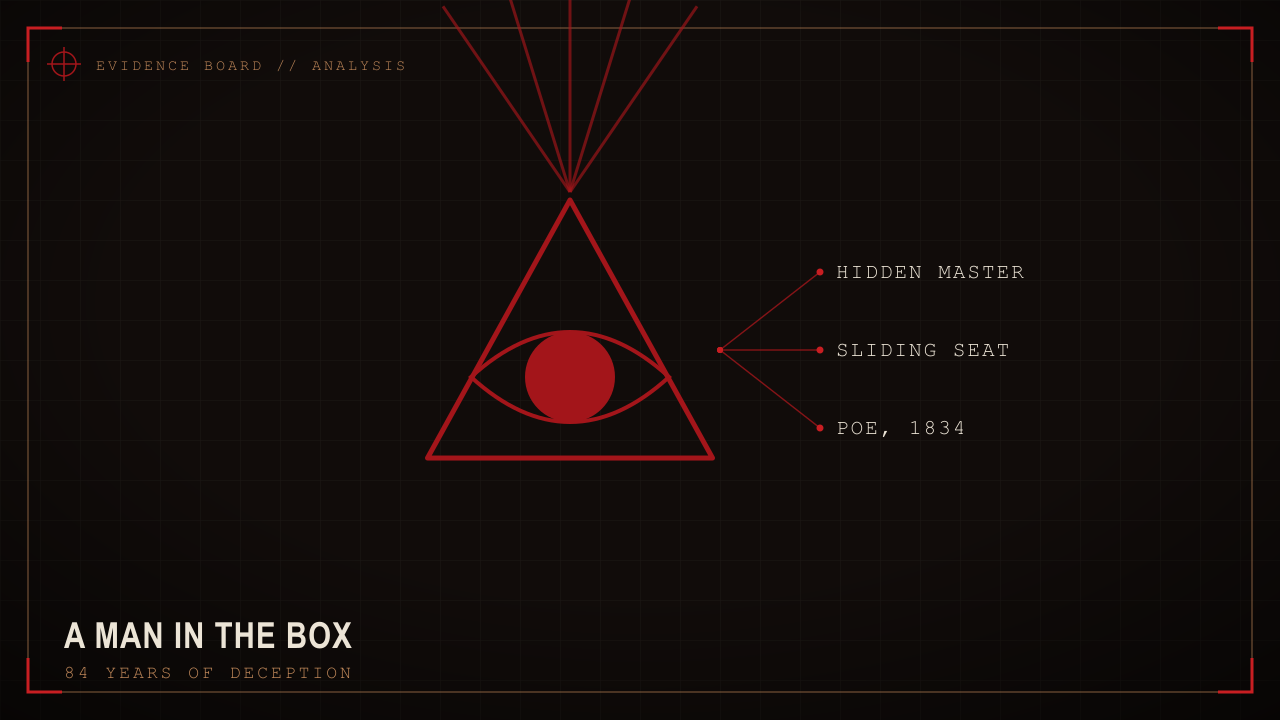
Let's reconstruct the deception in complete detail, because the genuine ingenuity of the thing deserves to be appreciated as the masterpiece of stagecraft it was. The cabinet measured roughly four feet wide, two feet deep, and three feet high, with the robed mannequin seated behind it. Inside was a living chess master, and keeping that person invisible through an open-door inspection was the entire art.
The interior was divided into compartments crowded with dummy machinery — a dense forest of brass gears and cylinders that served no function except to look like function. The operator sat on a sliding seat mounted on rails. As von Kempelen opened the leftmost doors to reveal 'the works,' the operator slid to the right, folding behind the machinery in the closed section. As he opened the right doors, the operator slid left, having already shifted. A false back and cleverly angled partitions meant that the lit candle held into the cabinet illuminated only the spaces the showman wished seen.
Reading the Board in the Dark
The board on top used magnetized pieces. Suspended beneath the board, inside the cabinet, hung a panel of corresponding magnets — small iron spheres on strings that rose and fell as pieces moved on the board above. The hidden operator, in near-total darkness, could read the entire game by watching which of these little markers shifted, illuminated by a candle whose smoke was vented through the mannequin's turban to avoid the telltale sign of smoke escaping an empty cabinet. Every detail had been anticipated. Even the smoke had an exit.
Moving the Arm
To make the mannequin move, the operator worked a pantograph — a linkage of connected arms that translated the motion of his hand into the larger, mechanical-looking motion of the Turk's arm above. A lever let the hand open and close to grip a piece. The motion was deliberately slow and jerky, partly from the mechanism and partly by design, because a smoothly natural motion would have undercut the illusion of machinery. The audience wanted to see a robot move like a robot, and the operator gave them exactly that.
The genius was not in hiding a man in a box. The genius was in making the box's emptiness the centerpiece of the show — turning the inspection itself, the very moment meant to expose the fraud, into the proof of the miracle.
The Operators: The Forgotten Grandmasters
The Turk played strong chess for the better part of a century not because of any single hidden player but because of a relay of them, and the anonymity forced on these skilled players is the quiet cruelty at the heart of the story. Over its career the cabinet concealed a succession of strong European players, swapped in and out as the machine toured and as operators aged, fell ill, or moved on. The machine got the glory. The players got a cramped, candlelit box and a vow of silence.
One operator, Johann Allgaier, a leading Austrian player, is generally credited with being inside for the celebrated game against Napoleon. Another, William Schlumberger, a strong French player, operated the Turk during its later American tours and died of yellow fever in Cuba while traveling with the machine. These were genuine chess talents whose names survive only as footnotes to the mannequin that took their credit. The Turk is remembered. The minds that actually won its games are an asterisk.
Maelzel: The Showman Who Bought the Secret
After von Kempelen's death, the Turk passed to Johann Nepomuk Maelzel, a showman and inventor — also associated with the metronome and with mechanical music machines — who restored the device and toured it relentlessly across Europe and then America. Maelzel understood that the Turk was a theatrical property as much as a machine, and he stage-managed its mystique with a professional's instinct for spectacle and secrecy.
It was under Maelzel's management, on the American tour, that the Turk drew the attention of a young magazine writer in Richmond, Virginia, who would expose the heart of the trick through reasoning alone. That writer was Edgar Allan Poe, and his essay deserves its own full reckoning, because it is arguably one of the first great works of detective logic in American letters — written by the man who would soon invent the detective story itself.
Poe the Detective: The Argument in Full
Poe's 1834 essay, 'Maelzel's Chess Player,' is a landmark not because every detail is correct — several are wrong — but because of the method, which is the method that would later animate his fictional detective Dupin and, through him, Sherlock Holmes. Poe reasoned from observation to a hidden truth that no one could see directly.
His central argument was almost philosophical. A true machine, he contended, would be perfect — a pure calculating engine that, once capable of playing chess at all, would play it flawlessly and win every time. Yet the Turk sometimes lost. To Poe, this fallibility was not a weakness in the machine but proof that there was no machine — that a fallible human mind sat behind the moves, capable of error precisely because it was human. He noticed too that the Turk played with the left hand, an oddity suggesting a cross-wired human arm. He observed the suspicious choreography of the cabinet's opening, the timing of moves, the way a man named Schlumberger was always present but never visible during play, and conspicuously absent at the exact moments the Turk performed.
Poe could not see the man. He simply refused to believe the box could think, and reasoned his way to the human he could not see. That refusal — the insistence that an apparent miracle must have a hidden human cause — is the entire posture of the investigator. It is the posture of this entire publication.
The Long Shadow: Why the Turk Still Matters
The Turk burned in a Philadelphia museum fire in 1854, and its final owner published a full confession of its mechanism, closing a secret that careful minds like Poe's had already cracked by reason. But the machine refuses to stay buried, because the question it poses has only grown sharper with time: when something appears to think, what is actually doing the thinking — and who is hidden inside?
When Amazon built a service that breaks digital work into tiny tasks performed by invisible human laborers and presents their output as if produced by software, they named it Mechanical Turk, and the joke is deliberate and dark. The pattern is everywhere now. 'Artificial intelligence' demos have, more than once, turned out to be powered partly by humans in low-wage offices, labeling and correcting and standing in for the machine that doesn't quite work yet. The cabinet has gone global and digital, but the structure is identical: human labor, hidden inside the appearance of automation, taking none of the credit.
The Investigator's Takeaway
So the file closes where it opened, on the most reliable principle in this line of work. When a machine seems to do the impossible, the impossible part is almost always a person you cannot see. The Turk fooled royalty and statesmen and philosophers for eighty-four years not because the engineering was flawless but because people wanted, badly, to believe a machine could think. That wanting is the eternal vulnerability the con artist exploits and the investigator must resist.
Two and a half centuries later, the same wanting drives a trillion-dollar industry, and the same question still pays the rent: when they show you a thinking machine, do not ask how clever the machine is. Ask who is folded inside the cabinet, reading the board in the dark, working the arm, and going home unnamed. Question everything that claims to think on its own. Always check the cabinet.
Kai Doss
Field Analyst
Laid-back by nature, dangerous when focused. Kai has an uncanny ability to find the thread that connects a 1970s government memo to a fast-food mascot. Nobody knows how. He claims it's intuition.
Connected Threads
More from Weird Facts
The Disaster the Soviet Union Hid for 29 Years: The Nedelin Catastrophe
On October 24, 1960, a Soviet R-16 missile exploded on the launchpad during fueling. At least 78 people died, including the commander of the Soviet Strategic Rocket Forces. The USSR denied it happened until 1989.
Oxford University Is Older Than the Aztec Empire (And That Should Bother You)
Teaching at Oxford began around 1096. The Aztec capital of Tenochtitlán was founded in 1325. The institution we still use today predates an entire empire that Europeans described as ancient when they arrived to destroy it.