The Algorithm Knows You're Angry: Social Media and the Attention Economy
In 2019, Facebook's internal researchers confirmed the platform's algorithm amplified divisive content because outrage generates engagement. The proposed fixes were rejected. The reason: implementing them would reduce growth metrics.
Let's start with what we know for certain. In 2019, Facebook's internal researchers completed a study examining whether the platform's algorithm was amplifying divisive, emotionally provocative content. Their finding: yes. Significantly. The study recommended changes. Those changes were not implemented.
The reason given, according to internal documents that later became public, was that the proposed fixes would reduce overall engagement. And engagement is the metric. Engagement is everything. One internal presentation reportedly put it with chilling economy: the algorithms exploit the human brain's attraction to divisiveness, and if left unchecked, would serve users more and more divisive content in pursuit of attention.
I want to walk through how this actually works, because 'the algorithm makes you angry' has become a slogan, and slogans are where understanding goes to die. The mechanism is real, it is documented, and it is more interesting — and more disturbing — than the slogan suggests.
The Emotion Hierarchy
Content that produces emotional reactions gets shared more than content that doesn't. This much is intuitive. The question is which emotions, and here the data is uncomfortably specific. Research analysing the spread of content across networks has repeatedly found the same ranking: anger travels faster than joy. Fear outperforms hope. Moral outrage — the specific feeling of righteous indignation at someone else's behaviour — is the rocket fuel of the modern internet.
One widely cited study found that each additional moral-emotional word in a message increased its spread by roughly 20% per word. Not per post. Per word. The vocabulary of outrage is, quite literally, optimised for transmission. The algorithm didn't invent this. It discovered it, the way water discovers the lowest point in a landscape.
The Machine Has No Opinion
This is the part people get wrong. The algorithm does not want you to be angry. It does not want anything. It is an optimisation process pointed at a single target — time on platform, or its proxies — and it climbs toward that target by testing billions of tiny variations and keeping whatever works. Outrage works. So the system, with no malice and no plan, evolves toward outrage the way a river evolves toward the sea. The absence of intent is what makes it hard to stop. There is no villain to fire.
This Is Not New. It Is Just Documented Now.
The attention economy — the commodification of human attention — has been theorised since at least the 1970s, when the economist Herbert Simon pointed out the thing that now seems obvious: in a world rich in information, attention becomes the scarce resource, and a wealth of information creates a poverty of attention. He wrote that in 1971. He had no idea.
What changed is scale and specificity. A 1970s newspaper could be sensationalist. A tabloid could scream from the newsstand. But it screamed the same headline at everyone. A 2025 social media platform can be sensationalist at the individual level, tuned to your specific emotional profile, updated in real time, and deployed to three billion people simultaneously, each receiving a different, personally optimised provocation.
The thing about a conspiracy theory is that it requires someone to be keeping a secret. The surveillance economy keeps no secrets. It publishes quarterly earnings reports and explains the whole mechanism to shareholders.
The Slot Machine in Your Pocket
Your phone is not neutral. The notification that just buzzed. The autoplay that continued without asking. The pull-to-refresh gesture — that small downward tug that makes the feed reload — was deliberately designed to mimic the variable-reward mechanism of a slot machine. You pull, and sometimes there's a reward and sometimes there isn't, and the unpredictability is the entire point, because intermittent reinforcement is the most powerful behavioural conditioning schedule known to psychology.
These are not accidents of design. They are features, engineered by teams that include behavioural psychologists, implemented in code, and continuously A/B tested against metrics that measure seconds of your attention. The man often credited with inventing the infinite scroll has publicly said he regrets it. He calls the wasted human time a kind of moral debt. He is, notably, no longer in the industry.
The Vocabulary of Capture
Listen to the language the industry uses about you when it thinks you aren't listening. Users are 'engaged' or they 'churn.' Attention is 'captured.' Features are designed to be 'sticky.' Products create 'hooks.' Daily active users are 'DAU.' This is not the vocabulary of a service. It is the vocabulary of capture — the language of an industry that has, with great precision, decided that you are not the customer. You are the inventory.
The Part That's Actually Conspiratorial
None of what's described above is secret. It is documented, peer-reviewed, occasionally front-page news, and sometimes confessed directly by the people who built it. The conspiracy, if there is one, is not in the mechanism. It is in the persistence — the fact that it continues, in plain sight, after being thoroughly exposed.
That regulatory frameworks remain structurally unable to impose meaningful constraints. That the companies have successfully framed a public-health problem as a free-speech problem, knowing the second frame is unwinnable in court and the first one would cost them. That the research documenting harm to teenagers can leak, dominate a news cycle, prompt a hearing, and change essentially nothing about the product. The cover-up isn't of the facts. The cover-up is of the fact that knowing the facts has not been enough.
What Do You Even Do With This?
I am not going to tell you to delete the apps. That advice is both useless and a little smug, and it pretends the problem is your willpower rather than a hundred billion dollars of optimisation pointed at your nervous system. But there is a smaller, more honest move available: notice the feeling before you act on it. When a post makes you furious, when your thumb is already moving toward 'share,' pause for exactly that motion. That flash of righteous heat is not a malfunction of the system. It is the system. It is the product working precisely as designed.
You are not being lied to about what the algorithm does. You are being told the truth in a format specifically engineered to ensure you're too activated to act on it.
The Verdict
Verdict: not a conspiracy, which is somehow worse. A conspiracy could be exposed and dismantled. This is a market equilibrium — a stable arrangement that every incentive in the system works to preserve, that harms people at the edges and profits enormously at the centre, and that has already survived its own exposure. The documents are public. The mechanism is admitted. The earnings are reported quarterly. And the feed keeps scrolling, because that is the one thing it was ever built to do.
Question everything. Starting with the next thing that makes you angry on a screen, and who, precisely, profits from the heat of it.
The Architecture of the Feed
To resist a machine you have to understand its anatomy, so let's open the feed up and look at the organs. The modern recommendation system is not one algorithm but a stack of them, each doing a different job, all pointed at the same target: predicting what will keep you engaged and serving it before you've consciously decided you want it.
At the bottom is candidate generation — out of the millions of possible posts, the system narrows to a few thousand you might plausibly see. Above that is the ranking model, a neural network that scores each candidate on dozens of predicted actions: probability you'll like it, comment, share, watch to completion, or — crucially — that you'll be provoked enough to write an angry reply. Each predicted action carries a weight, and the weights are tuned to maximize total engagement. The post you see at the top of your feed is the winner of a silent auction held in milliseconds, in which the currency is your predicted reaction.
Engagement Is a Proxy, and Proxies Rot
Here is the deep flaw, the one that explains almost everything downstream. The system cannot measure what you actually value. It cannot measure whether a post made you wiser, calmer, better informed, or closer to the people you love. It can only measure behavior: clicks, dwell time, reactions, shares. So it optimizes the proxy — engagement — and assumes the proxy stands in for value. It does not. Outrage generates engagement without generating value. Anxiety generates engagement. Doomscrolling is, by every metric the system can see, a wild success. The proxy and the goal have come apart, and the machine is racing toward the proxy.
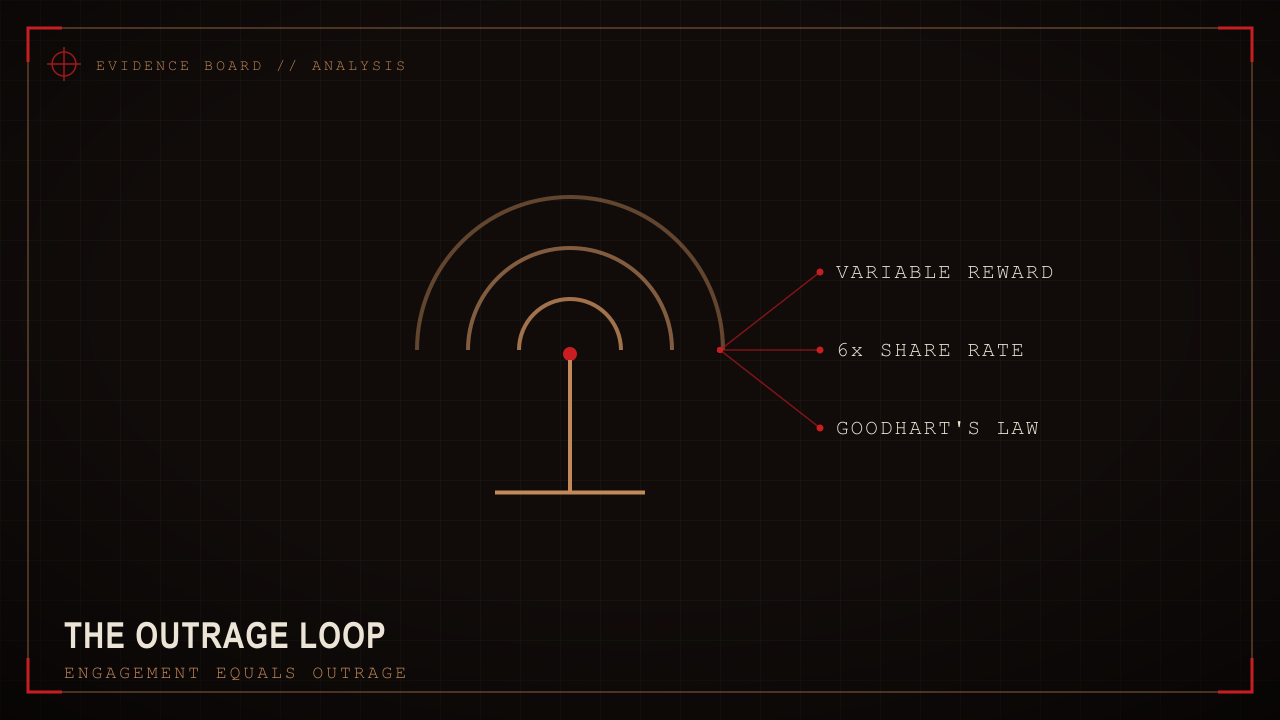
Economists call this Goodhart's Law: when a measure becomes a target, it ceases to be a good measure. The attention economy is Goodhart's Law operating at planetary scale, twenty-four hours a day, on three billion nervous systems at once.
The Casino in Your Hand: Variable Reward in Depth
We touched on the slot-machine comparison; now let's earn it properly, because the parallel is not a metaphor — it is the same psychological mechanism, deliberately ported from the gaming floor to the glass in your pocket.
In the 1950s the psychologist B.F. Skinner discovered that the most powerful way to make a behavior compulsive is not to reward it every time, but to reward it unpredictably. A pigeon that gets food every time it pecks will peck only when hungry. A pigeon that gets food on a random schedule will peck obsessively, far past satiation, because the uncertainty itself becomes the drive. This is the variable-ratio reinforcement schedule, and it is the single most effective conditioning pattern known to behavioral science.
Now consider pull-to-refresh. You tug the feed downward and wait through a half-second of suspense, and sometimes there is a glittering reward — a like, a message, a piece of news — and sometimes there is nothing. The reward is unpredictable. That is not a side effect. The interaction was modeled on the slot machine deliberately, by designers who understood exactly what intermittent reinforcement does to a brain. The notification badge, the little red dot, the swipe into a fresh deck of videos: all of it is the variable-ratio schedule, rebuilt in software and deployed at a scale Skinner could not have imagined.
A slot machine has to wait for you to come to the casino. The casino in your pocket comes to you, buzzes against your leg, and lights up your name. It never closes, it never sleeps, and it learns what you respond to a little better every single day.
The Dopamine Misunderstanding — Done Correctly
It has become fashionable to say these apps 'hijack your dopamine,' and the phrase is half right in a way that's worth correcting, because the truth is more precise and more alarming than the slogan.
Dopamine is not the 'pleasure chemical' of popular writing. It is, more accurately, the chemistry of anticipation and seeking — it spikes not when you get the reward but when you expect one, and it spikes hardest when the reward is uncertain. This is why the moment before you open the app is often more compelling than anything inside it. The seeking is the trap, not the finding. The apps don't make you happy; they keep you anticipating, in a loop where the anticipation is renewed before it can ever resolve into satisfaction. You are not being given pleasure. You are being kept hungry.
Surveillance: The Fuel Underneath It All
None of the targeting works without data, and the scale of the data collection is the part that should genuinely unsettle you, because it long ago exceeded what you knowingly provided. The system does not just know what you post. It knows what you typed and deleted. It knows how long you hovered over an image before scrolling past. It knows your location history, the other apps on your device, the networks you connect to, and — through tracking pixels embedded across the wider web — a great deal of what you do when you are not even using the app.
From this exhaust it builds a model of you that is, in narrow predictive terms, often better than your own self-knowledge. It can infer your mood, your vulnerabilities, the hours you are most impulsive, the topics that reliably hook you. This is the 'surveillance' in surveillance capitalism — a term coined by the scholar Shoshana Zuboff to name an economic order built on the extraction of human experience as raw material for prediction products. You are not the customer of these companies. The advertiser is the customer. You are the deposit being mined.
The Auction You're Sold Into
Every time a page with ads loads, a real-time bidding auction runs in the background, often completing in under a hundred milliseconds. Your profile — anonymized in theory, eerily specific in practice — is offered to advertisers who bid for the right to put something in front of you. You are, quite literally, sold thousands of times a day, in auctions you never see, at prices you never learn, based on a dossier you never agreed to and cannot inspect. This is not the dark web. This is the ordinary infrastructure of the open internet, running invisibly beneath nearly every free service you use.
The Documented Harms
We promised documentation, not vibes, so let's be concrete about what the internal research — the companies' own studies, leaked and testified — actually found, while staying careful about the limits of that evidence.
Internal research at a major platform found that a meaningful share of teenage girls who reported body-image problems traced them in part to the platform, and that the product made those feelings worse for a vulnerable subset. Internal documents discussed the algorithm's tendency to amplify divisive content and the company's decision not to fully implement fixes that would reduce engagement. Other research has linked heavy use to attention fragmentation and sleep disruption, though causation in these areas is genuinely hard to establish and reasonable researchers disagree about magnitude.
We flag the uncertainty deliberately, because overclaiming is its own kind of disinformation. The honest summary is this: the companies studied their own products, found real harms to real people — especially the young — understood the mechanisms, and repeatedly chose the version that protected engagement over the version that protected users. That choice is documented. It is not a theory.
Why Regulation Keeps Failing
If the harms are documented and the mechanisms are admitted, why does nothing change? This is the genuinely conspiratorial part, and the answer is structural rather than secret. The platforms have successfully framed a public-health question as a free-speech question, which moves the fight onto constitutional terrain where regulation is hardest to sustain. They have made their products so woven into commerce, politics, and daily logistics that 'just regulate them' threatens to break things voters depend on. And they spend on lobbying at a scale that ensures any rule that emerges is shaped, softened, and riddled with the exceptions they wrote themselves.
Meanwhile the cycle repeats with grim reliability: a leak, a scandal, a round of outraged headlines, a hearing in which executives apologize and promise to do better, and then nothing structural. The outrage at the company is processed by the same engagement machine the company built. The scandal trends, peaks, and is buried by the next scandal. The system metabolizes criticism of itself as just more content.
The cover-up is not of the facts. The facts are public. The cover-up is of the fact that knowing the facts has not been enough to change anything — and that this, too, was anticipated and absorbed.
What Actually Helps — Beyond 'Delete the App'
I won't insult you with the willpower lecture, because the problem was engineered by hundreds of people specifically to defeat your willpower, and treating it as a personal failing is exactly the framing that protects the system. But there are moves that work because they change the environment rather than relying on you to out-discipline a billion-dollar optimization loop.
Kill the notifications — all of them that aren't a human being directly contacting you. Notifications are the system's leash, the mechanism by which it pulls you back; sever the leash and you reclaim the decision to open the app. Put the phone in grayscale, which strips the color rewards the interface uses to light up your reflexes. Move the apps off the home screen so opening them requires a deliberate search rather than a reflexive tap. And practice the single most subversive act available: notice the feeling before you act on it. When the heat of outrage rises and your thumb drifts toward share, pause for exactly that motion. That flash of righteous fury is not yours. It is the product, working as designed.
The Verdict, Expanded
Not a conspiracy — something worse, because a conspiracy can be exposed and ended, and this cannot, because it is a market equilibrium that every incentive in the system conspires to preserve. The mechanism is admitted in earnings calls. The harms are recorded in internal studies. The fixes are known and shelved. And the feed keeps scrolling, metabolizing every exposé into more time-on-platform, because that is the one thing it was ever built to do and it does it to its own critics most efficiently of all.
You are not being lied to about what the algorithm does. You are being told the precise truth, in a format engineered to ensure you are too activated, too fragmented, and too continuously entertained to ever act on it. Question everything — and start with the next thing that makes you furious on a glowing screen, and ask, every time, who is being paid for the heat of it.
Kai Doss
Field Analyst
Laid-back by nature, dangerous when focused. Kai has an uncanny ability to find the thread that connects a 1970s government memo to a fast-food mascot. Nobody knows how. He claims it's intuition.
Connected Threads
More from Conspiracy Theories
Operation Mockingbird: The CIA Taught Journalists to Think
Operation Mockingbird was a real CIA program. It's declassified. The CIA recruited journalists, funded publications, and shaped editorial direction across American media for decades. The question isn't whether it happened — it's whether it stopped.
NASA's Missing 40 Hours: The Apollo 11 Footage Nobody Talks About
Between launch and splashdown, Apollo 11 ran for 195 hours. NASA broadcast roughly 17 of them. Amateur radio operators claim they heard things that never made it to air. NASA says the tapes were recorded over. Both facts are true.
The Phantom Time Hypothesis: Were 297 Years Quietly Erased from History?
German historian Heribert Illig argues that the Early Middle Ages — 614 to 911 AD — were fabricated. Three powerful men rewrote the calendar and invented three centuries that never happened. The calendar math is uncomfortably close.