The Phantom Time Hypothesis: Were 297 Years Quietly Erased from History?
German historian Heribert Illig argues that the Early Middle Ages — 614 to 911 AD — were fabricated. Three powerful men rewrote the calendar and invented three centuries that never happened. The calendar math is uncomfortably close.
In 1991, a German historian named Heribert Illig published a claim that should have broken academia in half. His argument: the years 614 to 911 AD never existed. Roughly three centuries of human history — the Carolingian dynasty, Charlemagne, the foundations of modern Europe — were, according to Illig, fabricated wholesale by three men with enough power to rewrite time itself.
The three men he named were Holy Roman Emperor Otto III, Pope Sylvester II, and Byzantine Emperor Constantine VII. Together, Illig argued, they conspired to place Otto's reign at the symbolically resonant year of 1000 AD — and to do so, they invented the years that would get them there. It is, on its face, one of the most audacious claims in the history of historiography. It is also, on closer inspection, more carefully constructed than its critics like to admit.
We want to be clear from the outset about where this investigation lands. The Phantom Time Hypothesis is wrong. The professional consensus against it is overwhelming and, in our judgement, correct. But a theory can be wrong and still be worth dismantling slowly, because the way it fails tells you something about how history is actually assembled — and about how much of what you 'know' about the past you have simply agreed to trust.
Who Was Heribert Illig?
Illig was not a fringe crank operating from a basement. He trained in literature and history, worked as a systems analyst, and edited a journal — Zeitensprünge ('Leaps in Time') — devoted to chronology revision. He was a serious member of a small but persistent intellectual tradition that questions the standard timeline of antiquity and the medieval period. That tradition includes figures like Anatoly Fomenko, the Russian mathematician whose 'New Chronology' makes Illig look conservative by comparison.
Understanding Illig's seriousness matters, because the easy dismissal — 'only a crackpot could believe this' — is lazy and, worse, it's wrong. The Phantom Time Hypothesis is interesting precisely because it was built by someone who understood the machinery of historical evidence and went looking for its weakest joints.
The Evidence That Doesn't Add Up
Illig's case rests on several pillars. The most compelling is the archaeological record — or rather, the lack of one. For a 300-year period, the physical evidence from Western Europe is, he claimed, remarkably thin. Buildings that should exist, don't. Administrative records are sparse in ways inconsistent with the bureaucratic traditions inherited from Rome.
He pointed to architectural gaps. Romanesque architecture, he argued, seems to pick up almost exactly where late Roman building styles left off, as though the intervening three centuries — which should have produced their own distinct evolution — simply weren't there. The styles are too continuous. The bridge between them is too short.
The Calendar Problem
There's also the calendar problem, and this is the part that lodges in your brain and refuses to leave. The Julian calendar accumulates an error of about one day per 128 years. By the time Pope Gregory XIII introduced the Gregorian calendar in 1582, it should have drifted roughly 13 days from the astronomical reality the original reform of 45 BC was calibrated against. It had drifted only 10.
That three-day gap, Illig argues, corresponds almost exactly to 297 phantom years inserted into the timeline. Run the arithmetic: roughly 128 years per day, multiplied by three days, lands you in the neighbourhood of 384 years — but if you anchor the Julian reform to the Council of Nicaea in 325 AD rather than to 45 BC, the numbers tighten considerably. Illig anchored to Nicaea. From there, the missing-days math becomes startlingly clean.
The calendar doesn't lie. It accumulates. And when you measured the accumulation, there was less of it than there should have been. That is the entire seed of the hypothesis, and it is not a stupid observation.
Charlemagne: The Ghost Emperor
Charlemagne — Karl der Große, Charles the Great — is one of the most significant figures in medieval history. He united much of Western Europe, was crowned Holy Roman Emperor on Christmas Day 800 AD, and left a legacy that shaped France, Germany, and the Catholic Church for centuries. He is also, according to Illig, a fiction. A character invented to populate the phantom centuries and to give the fabricated era a hero worth remembering.
Illig's argument about Charlemagne leans on the strange, larger-than-life quality of the man. He was, in the sources, almost impossibly accomplished: a near-illiterate who nonetheless sponsored a renaissance of learning; a conqueror who corresponded with the caliph of Baghdad; a ruler whose empire fragmented so completely and so quickly after his death that it left curiously little institutional residue. To Illig, Charlemagne reads like a legend dressed as a biography.
If you needed to invent 300 years, you'd need to invent the people who lived in them. You'd need a great man to anchor the story. Enter Charlemagne — too perfect, too pivotal, and too conveniently positioned to be entirely real.
The trouble, of course, is that Charlemagne left fingerprints everywhere. Coins. Capitularies. Charters. A body, eventually exhumed. A cathedral at Aachen that still stands and that visitors can walk through today. We'll come to why those fingerprints matter. For now, hold the image: an emperor accused of being a special effect.
How Do You Even Test a Claim Like This?
This is where the investigation gets genuinely interesting, because the Phantom Time Hypothesis is, unusually for a conspiracy theory, falsifiable. It makes a specific, checkable claim: a defined block of years did not happen. If you can find any independent record — astronomical, documentary, dendrochronological — that runs continuously through 614 to 911 AD and correlates with records on either side, the hypothesis collapses.
And here is the thing about a fabricated 300-year gap: you cannot fake it in only one place. To make it work, every civilisation on Earth that kept records would have to have agreed, simultaneously and without leaving a trace of the negotiation, to insert the same three centuries. The Chinese. The Islamic world. The Byzantines. Mesoamerican astronomers. Indian mathematicians. Every one of them, in on it, with no surviving memo.
Where the Theory Breaks Down
Illig's critics are numerous and credible. The most damaging counter-evidence comes from outside Europe: Islamic, Byzantine, and Chinese astronomers kept independent records of eclipses, cometary observations, and celestial events during the supposed phantom period. These records correlate with each other — and with the standard chronology. You cannot fake an eclipse observed simultaneously in Baghdad, Constantinople, and Chang'an, then cross-checked against modern astronomical back-calculation.
The Tree Rings
Then there is dendrochronology — the dating of events by tree-ring sequences. European oak chronologies now run continuously back more than ten thousand years, built from overlapping samples of living trees, building timbers, and bog oaks. There is no 297-year discontinuity in the ring record. The trees grew straight through Illig's phantom centuries, laying down one ring per year, indifferent to the politics of Otto III.
The Islamic Calendar
The Islamic calendar provides another independent clock. It is lunar, structurally different from the Julian solar calendar, and it has been counted continuously from 622 AD — squarely inside the alleged fabrication. The Hijri year count has no gap, no insertion, no seam. For Illig to be right, the entire Islamic world would have had to miscount its own most sacred chronology by three centuries and never notice.
So Why Does It Still Matter?
The Phantom Time Hypothesis doesn't survive scrutiny from professional historians, archaeologists, astronomers, or botanists. We say that plainly. But the theory matters for what it reveals about our relationship with recorded history. We trust the archive. We trust the calendar. The discomfort Illig's idea produces — even in readers who immediately reject it — is the discomfort of realising that someone, somewhere, had to write everything down. And writing is always an act of selection.
Most of what you believe about the year 700 AD, you believe on the authority of a chain of copyists, chroniclers, and historians, none of whom you have met, working from sources you have never seen. That chain is, in fact, robust — reinforced by tree rings and eclipses and coins and cathedrals. But the chain exists. Illig's gift, if you can call it that, was to make you notice it.
The Verdict
Verdict: false, and decisively so. The cross-civilisational astronomical record alone is fatal to the hypothesis, and the dendrochronological record buries it. There is no missing 297 years. Charlemagne was real. Aachen is real. The Early Middle Ages happened, slowly and unevenly and with frustratingly sparse documentation, exactly as the textbooks say.
And yet. The next time you read a date — any date, in any book, about any year you did not personally live through — notice the small act of faith you perform. The past is a document. And documents, even true ones, are written by someone. Question everything. Then check the tree rings.
The Wider Family of Chronology Revisionists
Illig did not invent chronological doubt; he inherited it. To understand where the Phantom Time Hypothesis sits, you have to map the strange intellectual lineage it belongs to — a tradition that runs from sober scholarship into genuine pseudoscience, with Illig somewhere uncomfortably in the middle.
The grandfather of the field is Sir Isaac Newton, who spent decades of his later life on 'The Chronology of Ancient Kingdoms Amended,' a serious attempt to recalibrate ancient history using astronomical retrocalculation. Newton concluded that conventional chronology had stretched the ancient world too long, and he tried to compress it. He was wrong in his conclusions, but he established a principle that haunts the field to this day: chronology is a reconstruction, not a fact handed down intact.
Then there is Immanuel Velikovsky, whose 1950 'Worlds in Collision' proposed that catastrophic planetary near-misses had rewritten ancient timelines. Velikovsky was demolished by astronomers, but his books sold enormously, proving a lasting market truth: people are hungry to be told that the official past is a lie.
Anatoly Fomenko and the New Chronology
The most extreme modern revisionist is the Russian mathematician Anatoly Fomenko, whose 'New Chronology' makes Illig look timid. Fomenko argues that essentially all of recorded history before roughly 1000 AD is fabricated, that Jesus lived in the twelfth century, and that ancient Rome, Greece, and Egypt are phantom reflections of medieval events. Fomenko's method leans on statistical analysis of king-lists and dynastic durations, claiming to find duplicate 'echoes' of the same events scattered across the timeline.
Fomenko's work is mathematically dressed and historically absurd, and it matters here because it reveals the failure mode of the whole genre: take a real observation — that ancient records are sparse, copied, and sometimes duplicated — and inflate it into a claim that history itself is a hoax. Illig is a more disciplined version of the same instinct, which is exactly why he's more dangerous to a casual reader. He sounds reasonable.
The Documentary Evidence Illig Has to Explain Away
A hypothesis is only as strong as its weakest evasion, and the Phantom Time Hypothesis has to perform some remarkable contortions to dispose of the documentary record. Consider the sheer volume of material that would have to be forged: charters, land grants, legal codes, church records, monastic chronicles, letters, and coins, all internally consistent, all referencing each other, all distributed across hundreds of institutions in dozens of kingdoms.
Take the Carolingian minuscule — the script developed under Charlemagne's educational reforms. It is a genuine paleographic revolution, a clean, readable hand that replaced a chaos of regional scripts and became the ancestor of the lowercase letters you are reading right now. For Illig to be right, someone would have had to invent not just documents but an entire evolutionary stage of handwriting, then age it convincingly, then seed it across the surviving manuscript tradition. Paleographers can date scripts by their letterforms the way geologists date strata. The script does not have a 297-year hole in it.
The Problem of the Coins
Numismatics is brutal for the phantom-time thesis. Coins are physical objects, struck in enormous numbers, buried in hoards, and dug up continuously by farmers, builders, and archaeologists who have no stake in any chronological debate. Carolingian coinage exists in quantity. The metallurgy is consistent with the period. The find-contexts — the layers of soil they emerge from — match the standard timeline. You cannot retroactively bury a forged coin in an undisturbed archaeological stratum without leaving evidence of the disturbance.
To fake 297 years you would need to fake the dirt. You would need to forge not just the documents but the depositional layers they were found in, the tree rings of the era, the eclipses observed across three continents, and the coins in ten thousand farmers' fields. At some point the conspiracy required to hide history becomes larger and more miraculous than history itself.
Why the Calendar Argument Feels Stronger Than It Is
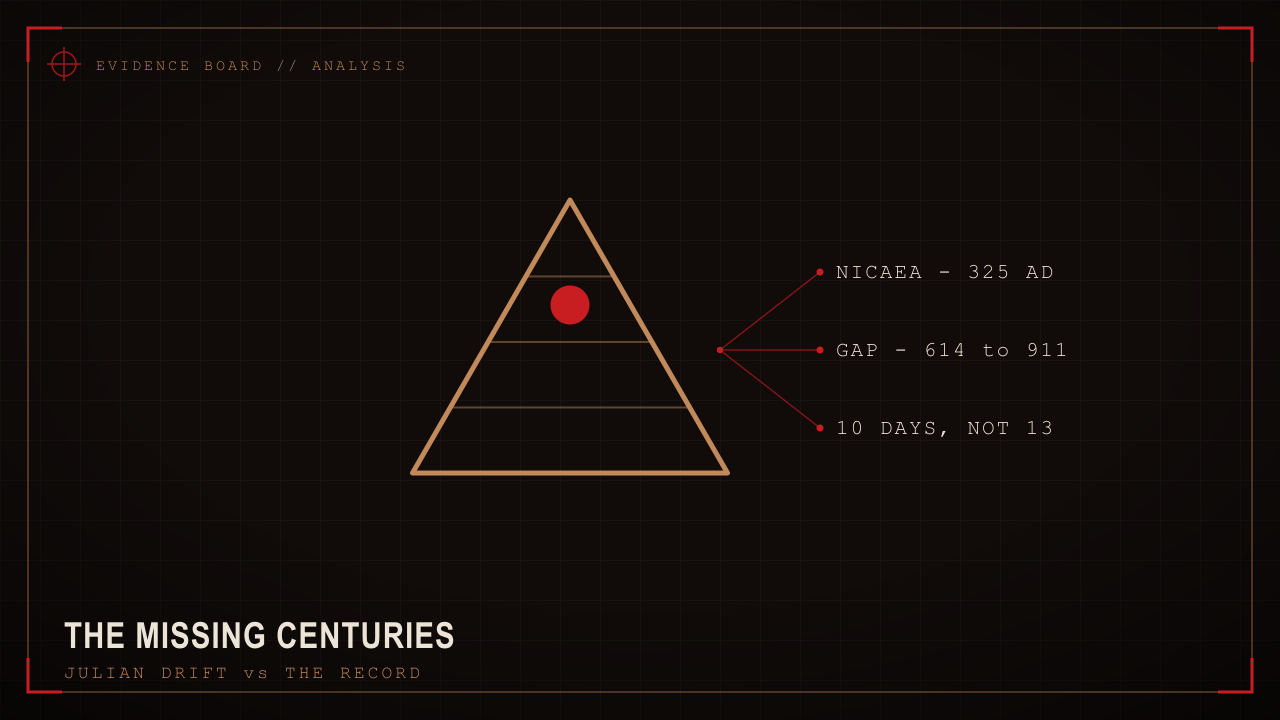
We should return to the calendar argument, because it is the part of Illig's case that lodges in the mind and refuses to leave, and it deserves a proper dismantling rather than a wave of the hand. Recall the claim: the Julian-to-Gregorian drift should have been about thirteen days but was corrected as only ten, and that three-day discrepancy maps onto 297 missing years.
The sleight of hand is in the anchor point. The drift depends entirely on which date you treat as the calendar's 'true' calibration. Illig anchors to the Council of Nicaea in 325 AD, because the Gregorian reform was explicitly designed to restore the date of the spring equinox to where it had been at Nicaea — around March 21st. From 325 to 1582 is about 1,257 years, and at one day of drift per 128 years, that produces almost exactly ten days. The math works perfectly under the standard chronology. There is no missing time. The Gregorian reform corrected the drift since Nicaea, not the drift since Julius Caesar — and the popes who commissioned it said so explicitly.
In other words, the calendar 'anomaly' that launched the entire hypothesis dissolves the moment you read the actual stated goal of the 1582 reform. The ten days were not a mystery the Vatican was hiding. They were the announced, arithmetic result of a deliberate calculation, documented in the papal bull 'Inter gravissimas.' Illig built a tower on a misread footnote.
What the Theory Gets Right Anyway
Here is where we resist the temptation to gloat, because a good investigation credits the opposition where credit is due. Illig is wrong about the 297 years. But he is right that the Early Middle Ages are genuinely, frustratingly under-documented compared to the periods on either side. The so-called 'Dark Ages' earned the name, in part, because the documentary light really does dim. Literacy contracted. Record-keeping fragmented. Whole regions go quiet in the written record for decades at a stretch.
That darkness is real, and it is the soil in which a theory like Illig's can germinate. When the evidence thins, the human mind reaches for a story to fill the gap, and 'they made it all up' is a seductively complete story. The correct response to a thin record is not to declare the period fictional but to sit with the discomfort of partial knowledge — which is, for most people, far harder than believing a conspiracy.
The Psychology of the Missing Piece
There is a cognitive reason phantom-time theories find an audience, and it is worth naming. The human brain treats absence of evidence as a vacuum to be filled, and it strongly prefers an intentional explanation — a someone — over an impersonal one. 'The records are sparse because society collapsed and fewer people wrote things down' is true but unsatisfying. 'The records are sparse because three powerful men deleted them' has a villain, a motive, and a shape. We are pattern-finding animals, and a conspiracy is a very satisfying pattern.
The Final Cross-Examination
Let us close the file by stacking the independent clocks against the hypothesis one last time, because the strength of the rebuttal is precisely that it comes from witnesses who never coordinated. The Chinese astronomical record — meticulously kept by a bureaucratic state with no knowledge of Charlemagne — logs eclipses and comets straight through the supposed phantom centuries, and they back-calculate correctly. The Islamic Hijri calendar counts unbroken from 622 AD. The Byzantine record, kept by Illig's own alleged conspirator Constantine VII, is internally continuous. European oak dendrochronology grows ring by annual ring with no seam. Greenland ice cores layer season by season with no missing strata.
Each of these is an independent timekeeping system maintained by people who could not have colluded — separated by language, religion, ocean, and in the case of the trees and the ice, by not being people at all. For Illig to be right, the trees of Ireland and the ice of Greenland and the astronomers of Baghdad and Chang'an would all have had to agree to insert the same three centuries. That is not a conspiracy. That is a miracle, and miracles are the one thing a skeptic is obliged to reject.
The Verdict, Restated
False. Comprehensively, multiply, redundantly false. The Phantom Time Hypothesis survives only in the narrow corridor of its single clever observation about the calendar, and that observation evaporates under the actual text of the 1582 reform. There is no missing 297 years. Charlemagne ruled, the minuscule was written, the coins were struck, and the oaks of Europe laid down one ring per year, indifferent to Otto III.
And yet the file stays open in a way that matters. Not because the theory is true, but because it taught us to notice the machinery — the chain of copyists and chroniclers and dendrochronologists on whose unglamorous, cross-checking labour your entire sense of the past quietly rests. The past is a document. Documents are written by someone. The miracle is not that history might be fake. The miracle is how many independent witnesses it takes to prove that it isn't — and that, this time, they all show up. Question everything. Then count the tree rings yourself.
Marcus Veil
Lead Investigator
Suited, skeptical, and allergic to anything that hasn't been cross-referenced at least twice. Marcus spent a decade in investigative journalism before concluding that the real story is almost always the one they didn't file.
Connected Threads
More from Conspiracy Theories
Operation Mockingbird: The CIA Taught Journalists to Think
Operation Mockingbird was a real CIA program. It's declassified. The CIA recruited journalists, funded publications, and shaped editorial direction across American media for decades. The question isn't whether it happened — it's whether it stopped.
The Algorithm Knows You're Angry: Social Media and the Attention Economy
In 2019, Facebook's internal researchers confirmed the platform's algorithm amplified divisive content because outrage generates engagement. The proposed fixes were rejected. The reason: implementing them would reduce growth metrics.
NASA's Missing 40 Hours: The Apollo 11 Footage Nobody Talks About
Between launch and splashdown, Apollo 11 ran for 195 hours. NASA broadcast roughly 17 of them. Amateur radio operators claim they heard things that never made it to air. NASA says the tapes were recorded over. Both facts are true.