NASA's Missing 40 Hours: The Apollo 11 Footage Nobody Talks About
Between launch and splashdown, Apollo 11 ran for 195 hours. NASA broadcast roughly 17 of them. Amateur radio operators claim they heard things that never made it to air. NASA says the tapes were recorded over. Both facts are true.
On July 20, 1969, an estimated 600 million people watched Neil Armstrong descend a ladder and step onto the lunar surface. The broadcast was historic. It was also approximately 17 hours of footage from an eight-day mission.
The math is straightforward: Apollo 11 launched on July 16 and splashed down on July 24. That's 195 hours. NASA broadcast roughly 17 hours of footage. This is not a conspiracy — it's publicly documented. The question that doesn't get asked nearly enough is: what happened in the other 178 hours?
Let's be disciplined about this from the start. 'Missing footage' is a phrase that does a lot of unearned work. There is a difference between footage that was never recorded, footage that was recorded and never aired, and footage that was recorded, aired, and then physically lost. All three apply to Apollo 11. Conspiracy theories thrive in the confusion between them. Our job is to pull them apart.
Where the '40 Hours' Number Comes From
The figure varies depending on who's telling the story — sometimes it's 40 hours, sometimes it's a vaguer 'missing days.' It generally refers to the gap between the total mission duration and the comparatively small slice that the public actually saw on television. But mission time is not the same as broadcast time, and conflating them is the original sin of this whole genre.
Of those 195 hours, a huge fraction was spent in transit — three days out, three days back — during which the most camera-worthy event was the crew sleeping in shifts. The lunar surface activity, the part everyone cares about, lasted about two and a half hours. The idea that 178 hours of suppressed drama is hiding somewhere assumes that every minute of a spaceflight is cinematic. It isn't. Most of it is checklists.
What Ham Radio Operators Picked Up
During the Apollo missions, a number of amateur radio enthusiasts and independent monitoring stations tracked the spacecraft's transmissions independently. This is true and important: Apollo's communications were not encrypted in the way a military operation's might be. With the right equipment and the right orbital geometry, private citizens really could listen in.
In 1979, former NASA employee Otto Binder claimed that ham radio operators intercepted communications between Houston and Apollo 11 that were not part of the official broadcast — transmissions in which the astronauts reportedly described seeing 'other spacecraft' in lunar orbit, parked on the rim of a crater. The quote that circulates — about objects watching the astronauts — has been repeated for decades.
Binder's claim has never been definitively verified, and Binder himself was a science-fiction author as well as a former NASA contractor, which is the kind of biographical detail that should make an investigator slow down. But the mechanics are plausible: NASA's broadcast used a selected subset of available channels. Other channels were not suppressed — they simply weren't aired. Anyone with the right equipment could, in theory, have been listening to what wasn't on television.
The transmissions weren't secret. They were just boring, technical, and not televised. 'Not broadcast' is not the same as 'hidden.' But to a certain kind of listener, the absence of a thing is the most exciting evidence of all.
The Tapes That Genuinely Are Gone
Here is where the story stops being speculation and becomes documented embarrassment. In 2006, NASA admitted that it had lost the original high-quality videotape recordings of the Apollo 11 moonwalk. Not the broadcast tapes — those survive. The originals: the slow-scan television signal as it came down from the Moon, recorded at a quality significantly higher than what was converted on the fly and pushed out to the world's TV networks.
The Moon's camera transmitted in a format incompatible with commercial television. At tracking stations in Australia and California, that signal was displayed on a monitor and re-filmed with a conventional TV camera for broadcast — a process that visibly degraded the image. The pristine original telemetry tapes were the good copy. And NASA taped over them.
Why Would Anyone Erase the Moon?
The answer is almost insultingly mundane. In the 1970s and 80s, magnetic tape was expensive and NASA was generating it by the mountain — satellite data, especially, devoured tape stock. The agency had a standard practice of returning old tapes to inventory to be reused. A multi-year investigation concluded that the Apollo 11 telemetry tapes were almost certainly degaussed and rewritten with later satellite data, their historic content gone, sacrificed to a supply budget.
You're telling me we sent humans to the moon, recorded it in the highest quality available, and then taped over it. Like a home video of a birthday party recorded over with a football match.
The Restoration Nobody Mentions
There's a coda to the lost-tapes story that the conspiracy version conveniently omits. Faced with the loss of the originals, NASA tracked down the best surviving broadcast-quality copies — from the CBS archive, from kinescope recordings, from the tracking stations — and hired the team that had restored old films digitally to clean them up. The 2009 restoration is sharper than what 1969 audiences saw. The good footage was lost; a better-than-broadcast version was rebuilt from fragments. That is not what a cover-up does. A cover-up does not commission a remaster and hold a press conference about it.
The Sensible Explanation
Here is what is almost certainly true: Apollo 11 was a military-adjacent operation during the Cold War. Operational security was real. Not every transmission would be shared publicly, not because of aliens or structures on the moon, but because broadcasting every private conversation between astronauts and ground control was neither practical nor desirable.
The footage gap exists because 178 hours of mission time includes sleeping, eating, systems checks, mid-course corrections, and procedural data with no broadcast value. The missing tapes — the genuinely missing ones — are the result of bureaucratic negligence and a tape budget, not a cover-up. The 'other spacecraft' transmissions rest on a single secondhand claim from a science-fiction author, unsupported by any of the thousands of hours of mission audio that NASA has, in fact, released in full.
The Part That Should Keep You Honest
And yet we'd be poor investigators if we tied this off too neatly. The lesson of the lost tapes is not that NASA hid the Moon. It's that the single most documented event in human history — watched live by a fifth of the planet — still managed to have its best evidence erased by accident, by an institution that had every reason to treasure it. If that can happen to Apollo 11, sitting in the bright light of history, ask yourself what survives of the events nobody was watching.
Almost certainly negligence. Almost certainly a tape budget. Almost certainly. Almost. Trust no 1 — including the part of yourself that finds the boring explanation too boring to be true.
How Apollo Communications Actually Worked
To judge any claim about 'missing' Apollo transmissions, you first have to understand the plumbing — and the plumbing is genuinely fascinating, because it explains both why amateurs could listen in and why so much never reached your television.
Apollo used several distinct radio links operating on different frequencies. There was the voice link between the crew and Mission Control. There was the biomedical telemetry — the astronauts' heart rates and respiration, streamed continuously to flight surgeons. There was spacecraft systems telemetry: thousands of data points on fuel, pressure, temperature, and attitude. And there was the television signal, which was its own separate, bandwidth-hungry channel that was only switched on for scheduled broadcasts.
All of this flowed through the Manned Space Flight Network — a ring of tracking stations spaced around the globe so that as the Earth rotated, at least one dish was always pointed at the spacecraft. The big antennas at Goldstone in California, Honeysuckle Creek and the Parkes radio telescope in Australia, and Madrid in Spain formed the backbone. When the Moon set over one station, another picked up the signal. This is why the famous first-step footage was actually received in Australia — the Moon was in the Australian sky at that hour.
Why Amateurs Could Hear It
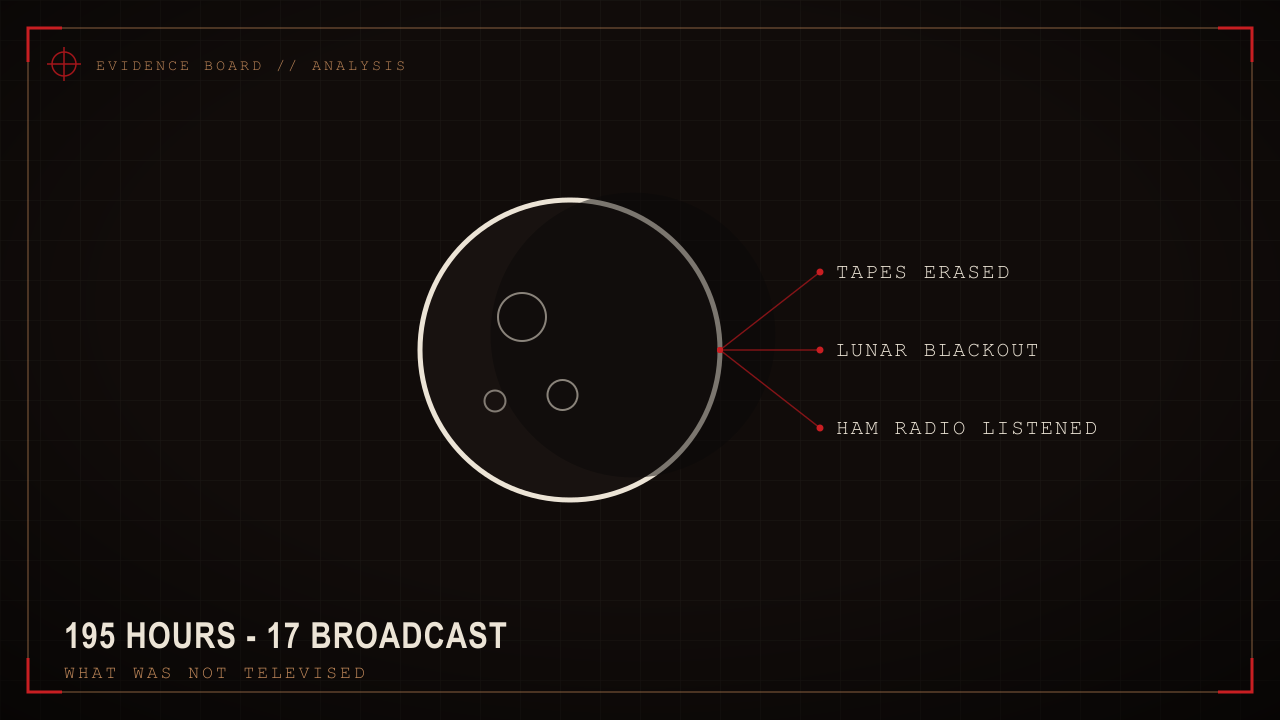
Apollo voice and telemetry were, for the most part, transmitted in the clear. There was no need to encrypt a scientific mission, and encryption would have added complexity and risk to systems where reliability was sacred. This means that a sufficiently equipped amateur — and the late 1960s had a thriving community of radio hobbyists — could, with the right antenna and receiver and a knowledge of the frequencies, pull Apollo signals out of the sky directly.
This is the kernel of truth at the center of every 'they heard secret transmissions' story. It was genuinely possible to hear things that weren't on TV. But 'not on TV' covered an ocean of mundane material — telemetry tones, systems chatter, medical data, housekeeping — and the leap from 'amateurs could hear untelevised audio' to 'amateurs heard the astronauts describe alien craft' is a leap across a canyon on the strength of a single unverified secondhand claim.
The Apollo 11 Timeline, Hour by Hour
Let's actually account for the 195 hours, because the entire 'missing 40 hours' framing collapses the moment you lay the mission out on a clock. The conspiracy depends on you never doing this arithmetic. So we'll do it.
Roughly three days were spent in translunar coast — the outbound cruise from Earth to the Moon. During this stretch the crew performed navigation sightings, mid-course corrections, equipment checks, meals, and sleep periods. There were a handful of scheduled TV broadcasts showing the crew floating around the cabin, and a great deal of time during which there was simply nothing to broadcast because three men were asleep or running checklists.
Then came lunar orbit, the descent, and the surface stay — Armstrong and Aldrin were on the Moon for about 21 and a half hours total, but the actual moonwalk (EVA) lasted about two and a half hours. Collins, meanwhile, orbited alone in the command module, passing repeatedly behind the Moon where radio contact was physically impossible — the Moon itself blocked the signal. Those communication blackouts are not suppression. They are orbital mechanics. You cannot radio through several thousand kilometers of rock.
Then the return: another three-day coast, more sleep, more checklists, the trans-Earth injection burn, and finally re-entry and splashdown. Add it up and the 'missing' hours are not missing at all. They are sleeping, eating, coasting, running diagnostics, and orbiting behind the Moon — none of which makes for compelling television, and almost none of which was ever claimed to have been broadcast.
The mission was 195 hours long and the interesting part was about two and a half. That ratio is not a cover-up. That is spaceflight, which is overwhelmingly composed of waiting, checking, and sleeping, punctuated by minutes of history.
The Slow-Scan Conversion: A Genuine Tragedy
We return to the lost tapes, because they deserve a fuller telling than the conspiracy version allows — the real story is sadder and more human than any cover-up.
The camera on the lunar module transmitted in a format called slow-scan television, running at a frame rate and line count incompatible with the commercial broadcast standards of 1969. The tracking stations in Australia and California received this pristine slow-scan signal and recorded it onto telemetry tape. But to get it onto the world's TV networks in real time, engineers pointed a standard broadcast television camera at a high-quality slow-scan monitor and re-filmed the screen. This optical conversion — a camera filming a monitor — visibly degraded the image. The ghostly, high-contrast footage the world saw was a copy of a copy, smeared by the conversion.
The original slow-scan telemetry tapes were the good version — clearer, with more detail and better contrast than anything broadcast. And those are the tapes that were lost. Not hidden. Lost. A multi-year search led by NASA in the 2000s concluded that the roughly 45,000 reels of Apollo-era telemetry tape had almost certainly been erased and reused during a 1970s and 80s tape shortage, when the agency was generating satellite data faster than it could buy fresh stock.
The Forensic Search
What is striking about the lost-tapes episode is how hard NASA worked to find them and how openly it admitted the failure. The search involved retired engineers, archival detectives, and the physical hunt through warehouses and storage facilities on multiple continents. They found documentation showing the tapes had been recalled to inventory. They found the procedures that governed reuse. They reconstructed, in effect, the bureaucratic crime scene — and the culprit was a supply budget, not a secret.
A cover-up buries the search. NASA published it. They held a press conference to announce that the most precious footage in their history had been taped over by accident, which is roughly the most embarrassing thing a space agency can confess, and they confessed it on the record. That is not the behavior of an institution hiding the Moon. That is the behavior of a bureaucracy owning up to losing its own crown jewels in a filing error.
The Restoration, and Why It Matters
There is a redemptive coda the conspiracy framing always omits. Having lost the originals, NASA assembled the best surviving broadcast-quality copies — kinescopes, the CBS archive, recordings made at the tracking stations — and hired a film restoration team to digitally enhance them. The 2009 restoration is sharper and more stable than what 1969 audiences saw on their sets.
Sit with the logic. If you had faked the Moon landing, the last thing you would ever do is reopen the footage decades later, subject it to forensic digital scrutiny, enhance it frame by frame, and publish the result for the entire world to pixel-peep. Restoration is the opposite of concealment. You do not remaster a lie. You bury it.
Who Was Actually Listening — And What They Heard
Independent confirmation of the Apollo landings does not rest on NASA's word. The Soviet Union — the one party on Earth with both the capability and the overwhelming motive to expose a faked American Moon landing — tracked the Apollo missions with its own deep-space network. They listened. They had every incentive in the Cold War to cry fraud. They never did, because they could see the spacecraft was where NASA said it was, doing what NASA said it did.
Amateur astronomers and radio operators worldwide tracked the missions too. Jodrell Bank in the UK, an independent radio observatory, monitored Apollo and the competing Soviet probes alike. The thousands of hours of mission audio that NASA has since released in full are searchable, transcribed, and pored over by enthusiasts. The 'alien craft' transmission appears in none of them. It exists in exactly one place: a 1979 secondhand account by a science-fiction author. That is not a record. That is a rumor with a footnote.
The most heavily scrutinized event in human history was watched live by a fifth of the planet and tracked by its sworn enemy, and the enemy — who would have paid any price to prove it false — stayed silent. That silence is louder than any leaked transmission.
The Lesson That Actually Survives
So we close the file where honesty demands. There is no suppressed 40 hours of alien encounters. The untelevised time was sleep and checklists and orbital blackout. The genuinely lost footage was lost to a tape budget, searched for openly, and partially recovered through a public restoration. The Soviets confirmed the landings by their silence.
But keep the one real lesson, because it is more unsettling than any conspiracy. The best evidence of the most documented event in history — the pristine original tapes — was destroyed by accident, by the very institution that had every reason to treasure it, through nothing more sinister than routine and a shortage of magnetic tape. If carelessness can erase the Moon landing, ask yourself what survives of all the events that no one thought to record at all. The danger to history is rarely a grand conspiracy. It is usually a supply clerk with a reuse quota. Trust no 1 — least of all the assumption that important things are automatically kept safe.
Marcus Veil
Lead Investigator
Suited, skeptical, and allergic to anything that hasn't been cross-referenced at least twice. Marcus spent a decade in investigative journalism before concluding that the real story is almost always the one they didn't file.
Connected Threads
More from Conspiracy Theories
Operation Mockingbird: The CIA Taught Journalists to Think
Operation Mockingbird was a real CIA program. It's declassified. The CIA recruited journalists, funded publications, and shaped editorial direction across American media for decades. The question isn't whether it happened — it's whether it stopped.
The Algorithm Knows You're Angry: Social Media and the Attention Economy
In 2019, Facebook's internal researchers confirmed the platform's algorithm amplified divisive content because outrage generates engagement. The proposed fixes were rejected. The reason: implementing them would reduce growth metrics.
The Phantom Time Hypothesis: Were 297 Years Quietly Erased from History?
German historian Heribert Illig argues that the Early Middle Ages — 614 to 911 AD — were fabricated. Three powerful men rewrote the calendar and invented three centuries that never happened. The calendar math is uncomfortably close.