Operation Mockingbird: The CIA Taught Journalists to Think
Operation Mockingbird was a real CIA program. It's declassified. The CIA recruited journalists, funded publications, and shaped editorial direction across American media for decades. The question isn't whether it happened — it's whether it stopped.
Here is the thing about Operation Mockingbird: it isn't a conspiracy theory. It's a documented historical fact, confirmed in the public record by the Senate's Church Committee in 1975, when investigators found that the CIA had maintained covert relationships with a substantial number of American journalists, and had used those relationships to influence coverage, plant stories, and suppress information inconvenient to U.S. foreign-policy interests.
Most conspiracy theories ask you to believe something the official record denies. This one asks you to believe something the official record already confirms — and then to sit with the much harder question of what, exactly, ever changed. That second question is where we'll spend most of our time, because it is the question the declassification was designed to make you stop asking.
The Origins
To understand Mockingbird you have to understand the early CIA, an institution founded in 1947 and staffed in significant part by veterans of the wartime Office of Strategic Services — men who had run propaganda, sabotage, and deception operations against the Axis and saw no reason to retire those tools just because the war had a different name now. The Cold War was, in their view, a war. And in a war, information is terrain.
The figure most associated with the early media operation is Frank Wisner, who ran the agency's covert-action wing and reportedly referred to his network of media assets as a 'mighty Wurlitzer' — an organ on which he could play any tune and have it harmonised across the world's press. The metaphor is worth sitting with. He didn't think of journalists as collaborators. He thought of them as keys.
How It Worked
The mechanism was elegant in its simplicity. The CIA had something journalists wanted: access. Information. Scoops. A journalist who cooperated received early tips, exclusive briefings, and access to sources that competitors couldn't touch. In return, they ran stories the agency wanted told, killed stories the agency wanted buried, and — in some cases — actively wrote or edited content under their own bylines that originated, in substance, with the agency.
Not every asset was a witting agent. This is the crucial subtlety. Some journalists knew exactly who they were working for. Others simply had a reliable, friendly source in government who fed them good material — material that happened to advance a particular agenda. The genius of the arrangement is that it did not require a newsroom full of spies. It required a newsroom full of ambitious people who liked good sources and didn't ask where the well-timed leak had really come from.
The Fronts
The program funded entire publications and organisations as fronts. The Congress for Cultural Freedom — which appeared to be an independent intellectual organisation promoting Western liberal values — was, for much of its existence, CIA-funded. It published respected journals, sponsored conferences, and underwrote the work of genuine, serious writers and artists across Europe and the Americas. Most of the participants had no idea whose money they were taking. The work was often real. The funding was a ghost.
The most effective propaganda is true. You don't need to make people lie if you can simply choose which truths get the budget, the platform, and the prize.
The Church Committee and What Happened Afterward
In 1975, Senator Frank Church convened his select committee to investigate abuses by the intelligence community in the wake of Watergate and a decade of leaks. The findings touched assassination plots, domestic surveillance, mail-opening programs, and the media relationships at the heart of Mockingbird. For a brief window, the machinery was visible, lit up by subpoena power and a country briefly willing to look.
The program was, officially, curtailed. The CIA announced it would no longer enter into paid or contractual relationships with accredited American journalists. Read that sentence again, slowly, because every qualifier in it is load-bearing. 'Paid.' 'Contractual.' 'Accredited.' 'American.' The announcement said nothing about unpaid relationships, informal arrangements, stringers, foreign journalists, or the simple, perfectly legal practice of being a very good source to a reporter you wished to influence.
An intelligence agency that stops influencing the press is an intelligence agency that has stopped doing intelligence. The question was never whether the relationships continued. The question is what shape they took once the law required them to be deniable.
Did It Actually Stop?
This is the heart of the file, and I want to be careful here, because this is exactly the point where documented history hands off to speculation, and an honest investigator marks that boundary clearly rather than smudging across it.
What we can say with confidence: the specific program described to the Church Committee was wound down, and the most egregious practices — handing a reporter a story written at Langley and watching it run under his name — became far riskier and, as far as the record shows, far rarer. What we cannot say is that the underlying dynamic ended, because the underlying dynamic was never illegal and never required a program. It required only proximity, ambition, and the eternal hunger of the press for access to power.
The Modern Landscape
There is no documented equivalent of Operation Mockingbird operating today, and you should be suspicious of anyone who claims otherwise without producing the document. But the relationship between the security state and the press did not dissolve; it went professional and, in a sense, public. The CIA now runs verified social media accounts and a recruitment-friendly podcast. Intelligence agencies maintain official liaisons with film and television productions, consulting on 'authenticity' in ways that reliably flatter the institution. Former officials populate cable-news green rooms as paid analysts.
None of that is covert. That's the point. The covert version was a scandal precisely because covertness was the crime. The overt version raises a subtler problem that no committee can subpoena: when the people explaining the security state to the public are the security state's own alumni, drawing the security state's pension, who is left to cover it as an adversary?
The Verdict
Verdict: confirmed, and that's the trap. Operation Mockingbird happened. It was real, it was wrong, and it was officially ended. The neatness of that arc — exposed, investigated, reformed — is itself a kind of reassurance, and reassurance is something an intelligence service knows how to manufacture. The declassified scandal becomes the proof that the system works, that abuses get caught, that the past is past.
The broader truth is harder and quieter: the mutual dependence between those who hold secrets and those who report on them is not a program that can be cancelled. It is a structure, and structures produce effects that look remarkably like the conspiracy without anyone ever having to break a law. The difference between a conspiracy and a system is that systems don't need coordinators — and they don't end with a Senate hearing. They just stop being news.
Question everything. Especially the sources who give you the best material for free.
The Men Who Built the Machine
Institutions are abstractions; the work is done by people, and the people who built the CIA's media apparatus are worth knowing, because their biographies explain the mindset that made it possible. These were not cynics. They were, in their own understanding, idealists fighting an existential war with the only tools they trusted — the ones they had used to fight the last one.
Frank Wisner, the architect of the agency's early covert operations, was a former OSS officer who emerged from the Second World War convinced that the struggle against Soviet communism was a continuation of the struggle against fascism by other means. He assembled a network of media relationships he reportedly called the 'mighty Wurlitzer' — the great theater organ on which he believed he could play a coordinated tune across the world's press. The metaphor is chilling precisely because it is musical. He did not think of the press as a watchdog to be deceived. He thought of it as an instrument to be played.
Cord Meyer, Tracy Barnes, and a roster of Ivy League patricians populated the upper ranks — men who moved easily between Georgetown dinner parties, newspaper boardrooms, and Langley, for whom the line between informing the public and shaping it had never been sharply drawn. This social intimacy is the part that gets lost in the spy-movie framing. The relationships were not handler-and-asset meetings in parking garages. They were lunches between old friends, one of whom happened to run a desk at the agency and the other a desk at a magazine.
The Mechanics of Influence, in Detail
How do you actually shape a free press without owning it? The Church Committee and subsequent disclosures sketched a toolkit, and it is more subtle and more durable than crude bribery. Understanding it is the difference between thinking Mockingbird was a discrete crime and understanding it as a template.
The Currency of Access
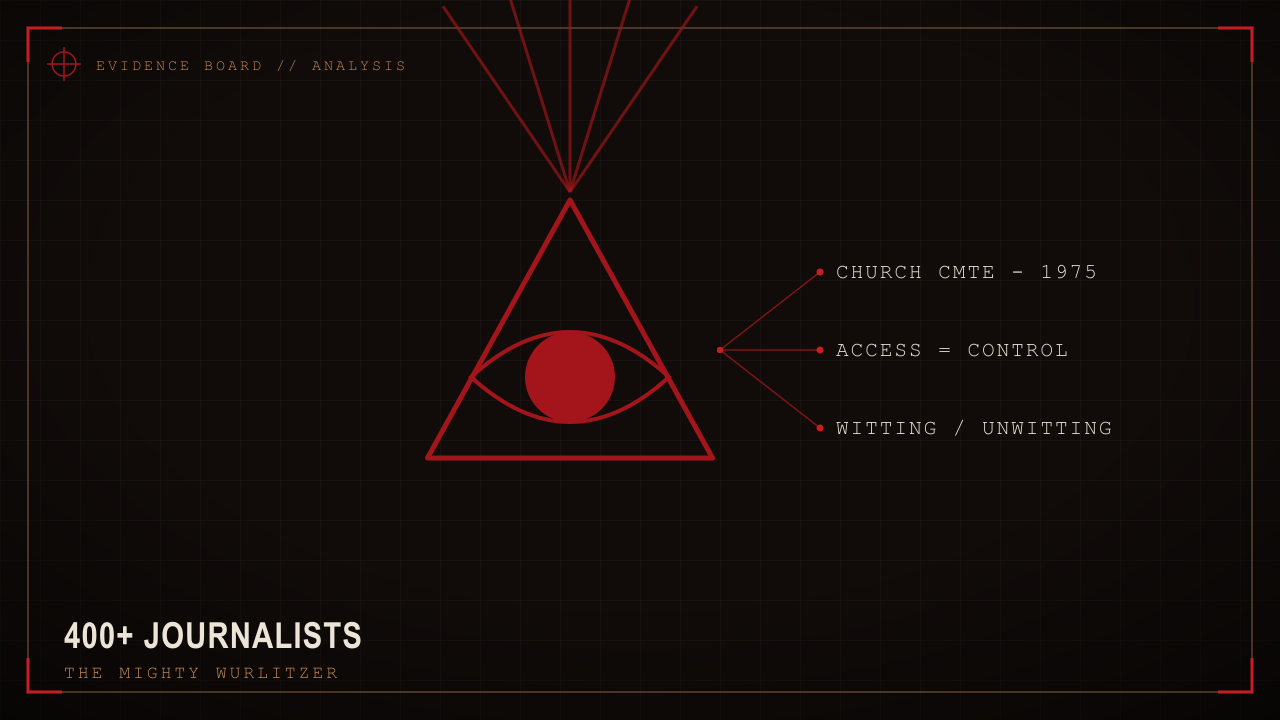
The foundational tool was access. An intelligence agency sits on the most valuable commodity in journalism: information the public cannot otherwise get. A reporter who cultivated a good relationship received tips, confirmations, background briefings, and the occasional exclusive that made a career. None of this required the reporter to be on a payroll. It required only that the well-timed leak flowed toward the cooperative and dried up for the troublesome. Over time, without a single explicit instruction, the incentive gradient shapes the coverage. The agency did not have to tell reporters what to write. It had to decide whom to feed.
Placement and Laundering
A second tool was placement — getting an idea into print where it would be read as independent journalism. A story planted in a pliable foreign newspaper could be 'replayed' by the wire services and picked up by the domestic American press as foreign reporting, its origin laundered by the time it reached a reader in Ohio. This blowback, where domestic audiences are influenced by propaganda meant for foreign ones, was a known hazard the agency discussed internally. The information ecosystem was global and interconnected long before the internet, and a lie set loose in Rome could be quoted as fact in New York within the week.
The Witting and the Unwitting
The most important distinction in the whole affair is between witting and unwitting assets. A small number of journalists knew exactly whom they served. A far larger number simply had an excellent source in government and never asked too hard where the perfectly packaged material originated. The genius — and the horror — of the system is that it ran mostly on the unwitting. You do not need a newsroom of spies. You need a newsroom of ambitious people who like good sources and don't interrogate their own luck. That machine needs no central conspiracy to keep running. It runs on careerism.
The perfect propaganda operation leaves no propagandists. It leaves only sources who were generous, reporters who were grateful, and stories that everyone agrees were simply true.
Case Files: Where Media Power Met Foreign Policy
Theory is cheap; let's look at the moments where the machinery and the history visibly intersect, while marking carefully the line between what is documented and what remains contested.
In 1953, the CIA orchestrated the overthrow of Iran's elected prime minister, Mohammad Mossadegh — a fact the agency itself has since acknowledged. The operation had an information dimension: shaping how the coup was understood at home and abroad, ensuring the press framed a foreign intervention as an indigenous uprising. The following year, the overthrow of Guatemala's government followed a similar pattern, with a propaganda apparatus, including a clandestine radio station, manufacturing the impression of a popular revolt. These are not theories. The broad outlines are in the declassified record and the agency's own histories.
Whether specific famous journalists were witting participants in specific operations is murkier, and an honest investigator stops at the edge of the documents rather than sprinting past it. The Church Committee confirmed the relationships existed in significant number; it did not, and we cannot, assign a secret allegiance to every prominent byline of the era. The temptation to retroactively brand every journalist one dislikes as a CIA asset is exactly the lazy overreach that discredits the real, documented history. Stay on the paper trail.
Project Mockingbird vs. 'Operation Mockingbird'
A point of precision that matters, because sloppiness here hands ammunition to people who want to dismiss the whole subject. There is a documented CIA effort literally named 'Project Mockingbird' — a wiretapping operation against journalists in the early 1960s, aimed at finding the sources of leaks. The broader, more famous 'Operation Mockingbird' — the media-asset network — is a name popularized largely by later authors and researchers rather than a single tidy program file with that title.
Skeptics seize on this to argue the whole thing is a myth. It is not. The underlying activity — the CIA's extensive covert relationships with journalists and media organizations — is thoroughly documented by the Church Committee and by the reporting of journalists like Carl Bernstein, who in 1977 published a major investigation describing more than 400 journalists who had carried out assignments for the agency over 25 years. The name is fuzzy. The activity is not. Don't let an argument about the label become an argument about the facts.
The Church Committee in Context
The 1975 investigation did not happen in a vacuum, and its context explains both its power and the limits of what followed. It came after Watergate had shattered public trust in government secrecy, after the Pentagon Papers had revealed years of official lying about Vietnam, and amid a cascade of leaks about intelligence abuses. For a brief, extraordinary window, the machinery of the secret state was dragged into the light of televised hearings, complete with the famous moment of a senator holding up a CIA dart gun designed to induce undetectable heart attacks.
The reforms that followed were real: permanent congressional oversight committees, an executive order restricting assassinations, new rules on domestic surveillance, and the CIA's public commitment to end paid relationships with accredited American journalists. This was not nothing. But read the reforms carefully and you see their shape: they constrained the most flagrant, most prosecutable conduct while leaving the underlying structure — the mutual dependence of the secret state and the press — entirely intact, because that structure was never illegal and could not be legislated away.
Did It Stop? The Honest Answer
This is the question every reader actually wants answered, and intellectual honesty requires me to give you a careful answer rather than a satisfying one. The satisfying answer — 'no, it never stopped, they're still doing it' — is unprovable in its strong form and is exactly the kind of unfalsifiable claim a good investigator distrusts. The dismissive answer — 'yes, it ended in 1976, the end' — requires believing that an institution voluntarily and permanently abandoned a tool that worked, which is its own kind of naïveté.
The defensible answer lives between them. The specific, flagrant practice — handing a reporter agency-written copy to run under his own name — became far riskier and, as far as the record shows, far rarer after 1976. But the dynamic that made Mockingbird possible was never a program; it was a relationship, and relationships between the powerful and the press do not end by decree. They evolve. They go professional. They acquire press offices and official liaisons and plausible deniability.
The Overt Era: Influence Without a Conspiracy
And here is the genuinely modern twist, the part that makes the old covert version look almost quaint. Today the intelligence community influences its own coverage largely in the open, which turns out to be more effective and entirely legal. The CIA runs verified social accounts and a glossy recruitment presence. Agencies maintain entertainment-liaison offices that consult on films and television, trading access and technical 'authenticity' for portrayals that flatter the institution. Former officials cycle directly from classified briefings into paid roles as network analysts, explaining the security state to the public while drawing the security state's pension.
None of this is covert, and that is precisely the point. The covert version was a scandal because covertness was the crime. The overt version raises a subtler problem no committee can subpoena: when the people who narrate national security to the public are its own alumni, sympathetic by formation and employment, who is left to cover the institution as an adversary? You don't need to plant a story when you've staffed the green room.
The most sophisticated information operation does not hide. It gets a verified badge, a recurring segment, and a consulting credit in the end titles of the spy thriller you watched last weekend.
The Verdict, Expanded
Confirmed — and that confirmation is itself the trap worth naming. Operation Mockingbird, in the substance if not the tidy file name, happened: an extensive covert web of relationships between the CIA and the American press, used to plant, kill, and shape stories over decades. It was exposed by a Senate committee and an investigative reporter, officially curtailed, and reformed. That clean arc — abuse, exposure, reform — is reassuring, and reassurance is a product the secret state knows how to manufacture. The declassified scandal becomes proof the system self-corrects, and the proof becomes permission to stop looking.
The deeper truth resists the tidy ending. The mutual dependence of those who hold secrets and those who report on them is not a program that can be canceled. It is a structure, and structures produce effects indistinguishable from a conspiracy without anyone breaking a law or attending a meeting. The difference between a conspiracy and a system is that a system needs no coordinator and ends with no hearing. It simply stops being news. Question everything — and be most suspicious of the source who hands you your best material for free, and the former insider who is paid to tell you it's nothing.
Marcus Veil
Lead Investigator
Suited, skeptical, and allergic to anything that hasn't been cross-referenced at least twice. Marcus spent a decade in investigative journalism before concluding that the real story is almost always the one they didn't file.
Connected Threads
More from Conspiracy Theories
The Algorithm Knows You're Angry: Social Media and the Attention Economy
In 2019, Facebook's internal researchers confirmed the platform's algorithm amplified divisive content because outrage generates engagement. The proposed fixes were rejected. The reason: implementing them would reduce growth metrics.
NASA's Missing 40 Hours: The Apollo 11 Footage Nobody Talks About
Between launch and splashdown, Apollo 11 ran for 195 hours. NASA broadcast roughly 17 of them. Amateur radio operators claim they heard things that never made it to air. NASA says the tapes were recorded over. Both facts are true.
The Phantom Time Hypothesis: Were 297 Years Quietly Erased from History?
German historian Heribert Illig argues that the Early Middle Ages — 614 to 911 AD — were fabricated. Three powerful men rewrote the calendar and invented three centuries that never happened. The calendar math is uncomfortably close.